Definition
Buildings are more than bricks, glass, and steel. In writing, they can represent strength, protection, growth, memories, success, or community. Instead of simply describing a building, writers use metaphors for buildings to create vivid images and deeper meanings.
A metaphor compares one thing directly to another without using “like” or “as.” For example, you might say, “The building is a giant guardian.” The building is not really a guardian, but the comparison helps readers imagine its strength and protective presence.
In simple terms, metaphors make writing more engaging and memorable. They are useful in stories, essays, poems, and speeches. Unlike simile sentences, metaphors create direct comparisons that make ideas easier to picture. Let’s explore 20 examples of metaphors for buildings and learn how to use metaphors in writing.
20 Metaphors for Buildings
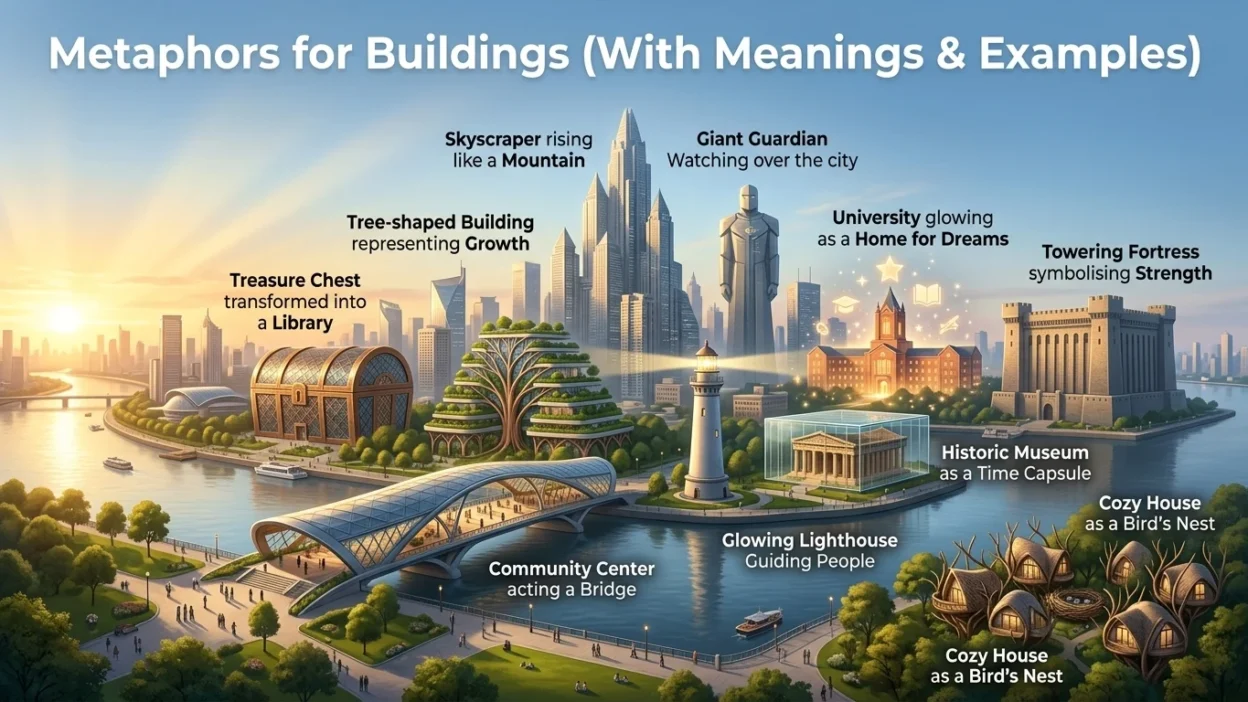
1. The building is a giant guardian.
Meaning: It protects people inside.
Explanation: A guardian symbolizes safety.
Example 1: The school stood as a giant guardian.
Example 2: The old church watched over the town.
2. The building is a fortress.
Meaning: It is strong and secure.
Explanation: A fortress represents protection.
Example 1: Their home became a fortress.
Example 2: The office stood like a fortress of ideas.
3. The building is a beacon.
Meaning: It gives hope or guidance.
Explanation: A beacon leads people forward.
Example 1: The library became a beacon of learning.
Example 2: The hospital was a beacon of hope.
4. The building is a heart.
Meaning: It is the center of activity.
Explanation: The heart gives life.
Example 1: The town hall became the city’s heart.
Example 2: The stadium was the heart of the community.
5. The building is a tree.
Meaning: It grows and supports life.
Explanation: Trees provide shelter and strength.
Example 1: The university became a growing tree.
Example 2: Students gathered beneath its branches of knowledge.
6. The building is a lighthouse.
Meaning: It guides people.
Explanation: Lighthouses show the right direction.
Example 1: The museum became a lighthouse of history.
Example 2: Visitors followed its light.
7. The building is a bridge.
Meaning: It connects people.
Explanation: Buildings often bring communities together.
Example 1: The community center became a bridge.
Example 2: It connected neighbors every day.
8. The building is a castle.
Meaning: It represents pride and importance.
Explanation: Castles symbolize greatness.
Example 1: Their mansion became a castle.
Example 2: The headquarters stood proudly.
9. The building is a treasure chest.
Meaning: It holds valuable things.
Explanation: Libraries and museums preserve knowledge.
Example 1: The library became a treasure chest.
Example 2: Every shelf held a new discovery.
10. The building is a book.
Meaning: It tells a story.
Explanation: Old buildings reflect history.
Example 1: The castle was an open book.
Example 2: Every wall revealed another chapter.
11. The building is a mountain.
Meaning: It appears powerful and lasting.
Explanation: Mountains symbolize stability.
Example 1: The skyscraper stood like a mountain.
Example 2: Nothing seemed to move it.
12. The building is a nest.
Meaning: It provides comfort and safety.
Explanation: Nests protect families.
Example 1: Their house became a warm nest.
Example 2: Everyone felt welcome inside.
13. The building is a stage.
Meaning: Life happens inside it.
Explanation: A stage is where stories unfold.
Example 1: The courthouse became a stage.
Example 2: Every day brought a new performance.
14. The building is a shield.
Meaning: It protects from danger.
Explanation: Shields provide defense.
Example 1: The shelter became a shield.
Example 2: It protected families during the storm.
15. The building is a puzzle.
Meaning: It has many connected parts.
Explanation: Every room serves a purpose.
Example 1: The hospital was a giant puzzle.
Example 2: Every piece worked together.
16. The building is an anchor.
Meaning: It provides stability.
Explanation: Anchors keep ships secure.
Example 1: The town hall was an anchor.
Example 2: It kept the community together.
17. The building is a crown.
Meaning: It is the city’s greatest feature.
Explanation: A crown symbolizes importance.
Example 1: The tower became the city’s crown.
Example 2: It stood above every rooftop.
18. The building is a time capsule.
Meaning: It preserves history.
Explanation: Old buildings hold memories.
Example 1: The museum became a time capsule.
Example 2: Visitors stepped into the past.
19. The building is a giant puzzle piece.
Meaning: It belongs to the larger city.
Explanation: Every building has a role.
Example 1: The school completed the neighborhood.
Example 2: Every structure fit perfectly.
20. The building is a home for dreams.
Meaning: It helps people achieve goals.
Explanation: Schools, offices, and homes shape the future.
Example 1: The university became a home for dreams.
Example 2: Every graduate carried those dreams forward.
Practical Exercise
- What is a metaphor?
- Complete: The building is a ________.
- Which metaphor represents protection?
- Which metaphor represents history?
- What does “The building is a beacon” mean?
- Which metaphor symbolizes comfort?
- Which metaphor represents stability?
- What does “The building is a book” suggest?
- Write your own metaphor for a building.
- Why do writers use metaphors for buildings?
Answers
- A direct comparison without using “like” or “as.”
- Guardian (or any suitable metaphor).
- Fortress, shield, or giant guardian.
- Time capsule or book.
- It guides or inspires people.
- Nest.
- Mountain or anchor.
- Buildings can tell stories through their history.
- Answers will vary.
- Metaphors make descriptions more vivid, meaningful, and memorable.
Conclusion
Metaphors for buildings help writers describe strength, safety, history, and community in creative ways. Instead of simply describing a structure, you can call it a fortress, a beacon, a nest, a mountain, or a home for dreams. These examples of metaphors make stories, essays, and poems more engaging and expressive. Try creating your own building metaphors by thinking about what a building represents. With practice, your creative writing will become richer, clearer, and more memorable.

Michael Luca is a dedicated content writer at Metaphorox.com, specializing in metaphors, similes, and idioms. He develops informative and engaging articles that help readers enhance their language skills and understand figurative expressions more effectively.