Definition
Sometimes a movie, class, speech, or book feels so dull that the word “boring” doesn’t seem strong enough. That’s where metaphors for boring become useful. They help you describe dull moments in a creative way that readers can easily picture.
A metaphor compares one thing directly to another without using “like” or “as.” For example, you might say, “The meeting was a sleeping turtle.” The meeting wasn’t really a turtle, but the comparison shows how slow and uninteresting it felt.
In simple terms, metaphors make writing more colorful and memorable. They are common in stories, essays, poems, and everyday conversations. Unlike simile sentences, metaphors make direct comparisons that create stronger images. Let’s explore 20 examples of metaphors for boring and learn how to use metaphors in writing.
20 Metaphors for Boring
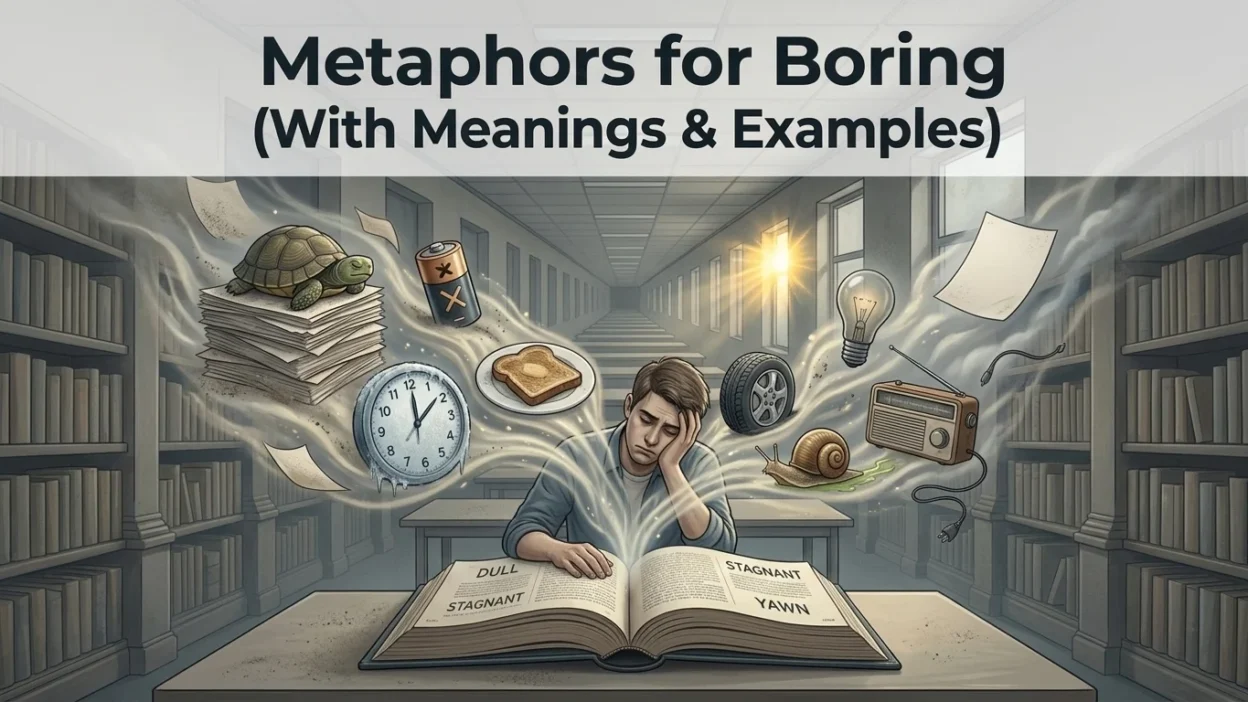
1. The lecture was a sleeping turtle.
Meaning: It moved very slowly.
Explanation: A sleeping turtle suggests little action.
Example 1: The lecture became a sleeping turtle.
Example 2: Time barely moved in class.
2. The movie was dry toast.
Meaning: It lacked excitement.
Explanation: Dry toast is plain and uninteresting.
Example 1: The movie was dry toast.
Example 2: Everyone expected more flavor.
3. The meeting was a frozen clock.
Meaning: Time seemed to stop.
Explanation: A frozen clock never moves.
Example 1: The meeting felt endless.
Example 2: It was a frozen clock.
4. The speech was gray paint.
Meaning: It had no energy.
Explanation: Gray paint suggests dullness.
Example 1: The speech covered the room in gray paint.
Example 2: Nobody looked interested.
5. The story was cold soup.
Meaning: It was disappointing.
Explanation: Cold soup lacks warmth and enjoyment.
Example 1: The story was cold soup.
Example 2: It left everyone unsatisfied.
6. The class was an empty road.
Meaning: Nothing exciting happened.
Explanation: An empty road feels lonely and quiet.
Example 1: The lesson became an empty road.
Example 2: No interesting ideas appeared.
7. The conversation was stale bread.
Meaning: It lacked freshness.
Explanation: Stale bread is old and unappealing.
Example 1: The conversation felt like stale bread.
Example 2: Nobody had anything new to say.
8. The book was a flat tire.
Meaning: It lost momentum.
Explanation: A flat tire slows everything down.
Example 1: Halfway through, the book became a flat tire.
Example 2: I struggled to finish it.
9. The show was an empty room.
Meaning: It lacked life.
Explanation: Empty rooms feel quiet and dull.
Example 1: The show was an empty room.
Example 2: The audience seemed disconnected.
10. The lesson was a snail.
Meaning: It moved very slowly.
Explanation: Snails represent slow progress.
Example 1: The lesson crawled by.
Example 2: It became a snail.
11. The game was a dead battery.
Meaning: It had no energy.
Explanation: Dead batteries cannot power anything.
Example 1: The game felt like a dead battery.
Example 2: Nobody seemed excited.
12. The day was a blank page.
Meaning: Nothing memorable happened.
Explanation: A blank page has no story.
Example 1: Today was a blank page.
Example 2: Nothing stood out.
13. The trip was a slow elevator.
Meaning: It felt endless.
Explanation: Slow elevators test patience.
Example 1: The journey became a slow elevator.
Example 2: We waited forever.
14. The performance was an unplugged radio.
Meaning: It lacked excitement.
Explanation: An unplugged radio makes no sound.
Example 1: The performance felt silent.
Example 2: It was an unplugged radio.
15. The party was a quiet desert.
Meaning: There was no fun or energy.
Explanation: Deserts can seem empty and silent.
Example 1: The party became a quiet desert.
Example 2: People left early.
16. The discussion was wet cardboard.
Meaning: It felt lifeless.
Explanation: Wet cardboard is dull and heavy.
Example 1: The discussion became wet cardboard.
Example 2: No one stayed interested.
17. The program was a dusty shelf.
Meaning: It felt old-fashioned.
Explanation: Dusty shelves suggest neglect.
Example 1: The program was a dusty shelf.
Example 2: It needed fresh ideas.
18. The novel was plain oatmeal.
Meaning: It was ordinary.
Explanation: Plain oatmeal can seem bland.
Example 1: The novel tasted like plain oatmeal.
Example 2: It lacked excitement.
19. The event was a dim light.
Meaning: It lacked energy.
Explanation: Dim lights are weak and dull.
Example 1: The event became a dim light.
Example 2: Nothing exciting happened.
20. The afternoon was an endless hallway.
Meaning: Time seemed never-ending.
Explanation: Long hallways feel repetitive.
Example 1: The afternoon was an endless hallway.
Example 2: The clock moved slowly.
Practical Exercise
- What is a metaphor?
- Complete: The lecture was a sleeping ________.
- Which metaphor represents slow time?
- Which metaphor suggests no energy?
- What does “The meeting was a frozen clock” mean?
- Which metaphor compares boredom to plain food?
- Which metaphor represents an uninteresting day?
- What does “The show was an empty room” suggest?
- Write your own metaphor for something boring.
- Why do writers use metaphors for boring situations?
Answers
- A direct comparison without using “like” or “as.”
- Turtle.
- A frozen clock or an endless hallway.
- A dead battery or a dim light.
- Time seemed to stop because the meeting felt dull.
- Dry toast, cold soup, or plain oatmeal.
- A blank page.
- It lacked excitement and life.
- Answers will vary.
- They make dull situations more vivid, engaging, and memorable.
Conclusion
Metaphors for boring help writers describe dull experiences in creative ways. Instead of simply saying something was boring, you can describe it as a frozen clock, dry toast, a dead battery, or an endless hallway. These examples of metaphors make your writing more interesting and easier to imagine. Practice creating your own metaphors by thinking about everyday situations. The more you practice, the stronger and more engaging your creative writing will become.