What Are Metaphors for Poetry?
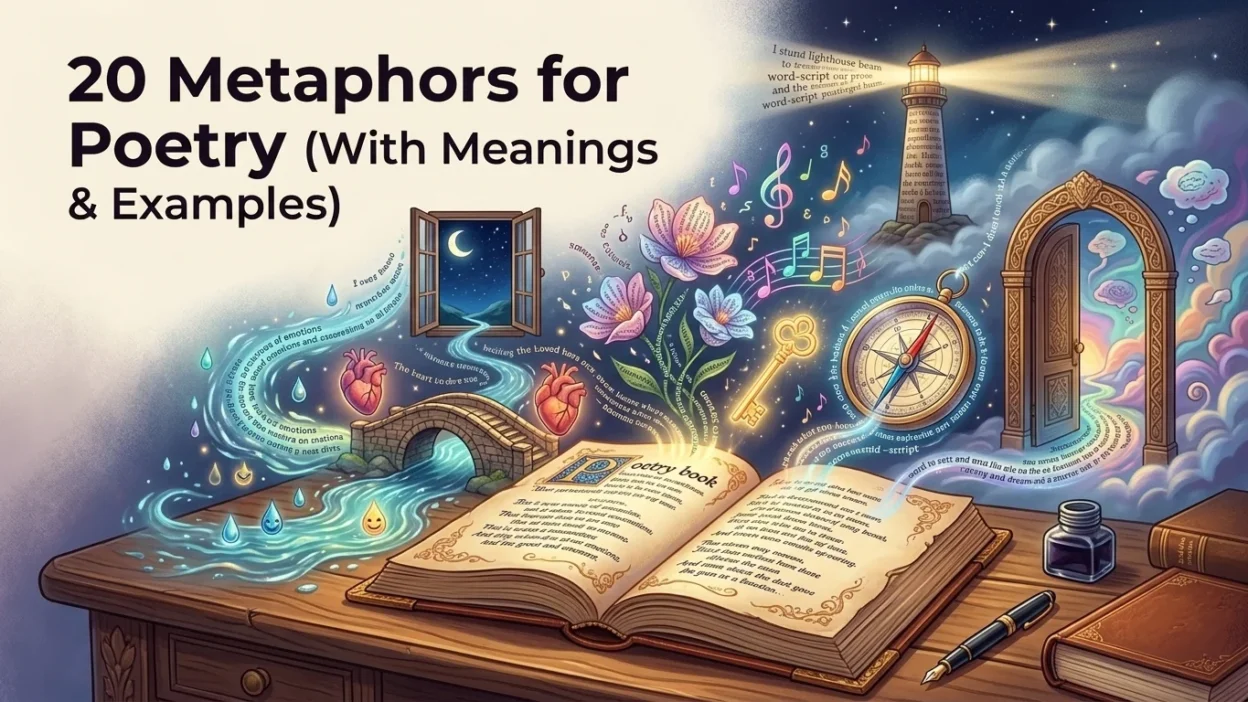
Poetry is more than words arranged in lines. It can hold emotions, memories, dreams, ideas, and stories. Metaphors for poetry help us describe what poetry is and how it affects readers in a creative way.
A metaphor compares one thing directly to another without using “like” or “as.” For example, you might say, “Poetry is a window to the soul.” Poetry is not a real window. The metaphor means that poems can reveal deep thoughts and feelings.
In simple terms, metaphors make ideas easier to picture and feel. They add color, emotion, and imagination to writing. Unlike simile sentences, metaphors make direct comparisons. They are especially useful in poems because they can express a big idea in only a few words. Let’s explore 20 examples of metaphors for poetry and learn how to use metaphors in writing.
20 Metaphors for Poetry
1. Poetry is a window to the soul.
Meaning: Poetry reveals deep feelings and thoughts.
Explanation: A window allows others to see what is inside.
Example 1: Her poetry was a window to the soul.
Example 2: Each poem opened a window into her feelings.
2. Poetry is music made of words.
Meaning: Poetry has rhythm and beauty.
Explanation: Words can create patterns similar to music.
Example 1: His poetry was music made of words.
Example 2: Every line carried its own rhythm.
3. Poetry is a river of emotions.
Meaning: Poetry allows feelings to flow freely.
Explanation: A river suggests movement and depth.
Example 1: The poem was a river of emotions.
Example 2: Her feelings flowed through every line.
4. Poetry is a mirror.
Meaning: Poetry can reflect life and feelings.
Explanation: A mirror shows us what already exists.
Example 1: Poetry is a mirror of human experience.
Example 2: The poem reflected his deepest thoughts.
5. Poetry is a garden of words.
Meaning: Poetry contains beautiful and creative language.
Explanation: Words can grow into meaningful ideas.
Example 1: Her poetry was a garden of words.
Example 2: Every verse was a new flower.
6. Poetry is a bridge between hearts.
Meaning: Poetry connects people through emotion.
Explanation: A bridge brings separate places together.
Example 1: Poetry became a bridge between hearts.
Example 2: The poem connected readers across generations.
7. Poetry is a painting with words.
Meaning: Poetry creates pictures in the imagination.
Explanation: Writers use words as artists use paint.
Example 1: The poem was a painting with words.
Example 2: Each line added color to the scene.
8. Poetry is a key.
Meaning: Poetry can unlock thoughts and emotions.
Explanation: A key opens something that was closed.
Example 1: Poetry was the key to her imagination.
Example 2: The poem unlocked an old memory.
9. Poetry is a journey.
Meaning: Reading or writing poetry can lead to discovery.
Explanation: A journey involves movement and new experiences.
Example 1: Every poem is a journey.
Example 2: The final line brought the journey home.
10. Poetry is a flame.
Meaning: Poetry can inspire passion and ideas.
Explanation: A flame represents energy and inspiration.
Example 1: Poetry was a flame in his mind.
Example 2: One verse kept the flame alive.
11. Poetry is a time machine.
Meaning: Poetry can bring the past to life.
Explanation: Poems can preserve memories and moments.
Example 1: The old poem was a time machine.
Example 2: Its words carried her back to childhood.
12. Poetry is a lighthouse.
Meaning: Poetry can offer guidance and hope.
Explanation: A lighthouse helps people find direction.
Example 1: Poetry became a lighthouse in difficult times.
Example 2: The poem offered a light in the darkness.
13. Poetry is a puzzle.
Meaning: Some poems require thought to understand.
Explanation: Readers may need to explore hidden meanings.
Example 1: The poem was a beautiful puzzle.
Example 2: Every image was another piece.
14. Poetry is a heartbeat.
Meaning: Poetry carries emotion and rhythm.
Explanation: A heartbeat represents life and feeling.
Example 1: Rhythm was the heartbeat of the poem.
Example 2: Every line carried a steady pulse.
15. Poetry is a seed.
Meaning: A small poem can grow into a large idea.
Explanation: A seed represents growth and possibility.
Example 1: The poem planted a seed in my mind.
Example 2: That small idea grew for years.
16. Poetry is a doorway.
Meaning: Poetry opens new worlds and ideas.
Explanation: A doorway gives access to something beyond.
Example 1: Poetry was a doorway to imagination.
Example 2: Each poem opened a different world.
17. Poetry is a conversation with silence.
Meaning: Poetry expresses thoughts that may be difficult to say.
Explanation: Quiet moments can hold deep meaning.
Example 1: The poem was a conversation with silence.
Example 2: The pauses spoke as strongly as the words.
18. Poetry is a treasure chest.
Meaning: Poetry contains valuable ideas and emotions.
Explanation: Readers can discover meaning within each poem.
Example 1: The book was a treasure chest of poetry.
Example 2: Every page held something valuable.
19. Poetry is a compass.
Meaning: Poetry can guide thoughts and understanding.
Explanation: A compass helps people find direction.
Example 1: Poetry became her inner compass.
Example 2: The poem pointed toward a new idea.
20. Poetry is a dream written down.
Meaning: Poetry gives form to imagination.
Explanation: Poems can capture ideas that feel magical or unreal.
Example 1: Poetry is a dream written down.
Example 2: His poem turned imagination into words.
Practical Exercise
- What is a metaphor?
- Complete: Poetry is a window to the ________.
- Which metaphor shows that poetry creates mental pictures?
- Which metaphor represents rhythm and emotion?
- What does “poetry is a bridge between hearts” mean?
- Which metaphor suggests hidden meanings?
- Which metaphor connects poetry with memories?
- What does “poetry is a seed” mean?
- Write your own metaphor for poetry.
- Why do poets use metaphors?
Answers
- A direct comparison without using “like” or “as.”
- Soul.
- Poetry is a painting with words.
- Poetry is a heartbeat.
- Poetry connects people through shared emotions.
- Poetry is a puzzle.
- Poetry is a time machine.
- A small poem or idea can grow into something meaningful.
- Answers will vary.
- Metaphors make ideas more vivid, emotional, and imaginative.
Conclusion
Metaphors for poetry help us explain the beauty and power of poetic writing. Poetry can be a window to the soul, a river of emotions, a painting with words, or a dream written down. These examples of metaphors turn abstract ideas into clear and memorable images. They also show how creative writing metaphors can add emotion and deeper meaning to language. Try creating your own metaphor by asking yourself what poetry feels like to you. With practice, you can make your poems and descriptions more vivid, expressive, and memorable.