Definition
Confusion is something everyone experiences. Sometimes you cannot find the right answer, understand a situation, or decide what to do next. Instead of simply saying “I am confused,” writers use metaphors for confusion to paint a clearer picture of that feeling.
A metaphor compares one thing directly to another without using “like” or “as.” For example, you might say, “My mind is a tangled web.” Your mind is not really a web, but the comparison helps readers imagine how complicated your thoughts feel.
In simple terms, metaphors make writing more expressive and memorable. They are useful in stories, poems, essays, and conversations. Unlike simile sentences, metaphors make direct comparisons that add emotion and depth. Let’s explore 20 examples of metaphors for confusion and learn how to use metaphors in writing.
20 Metaphors for Confusion
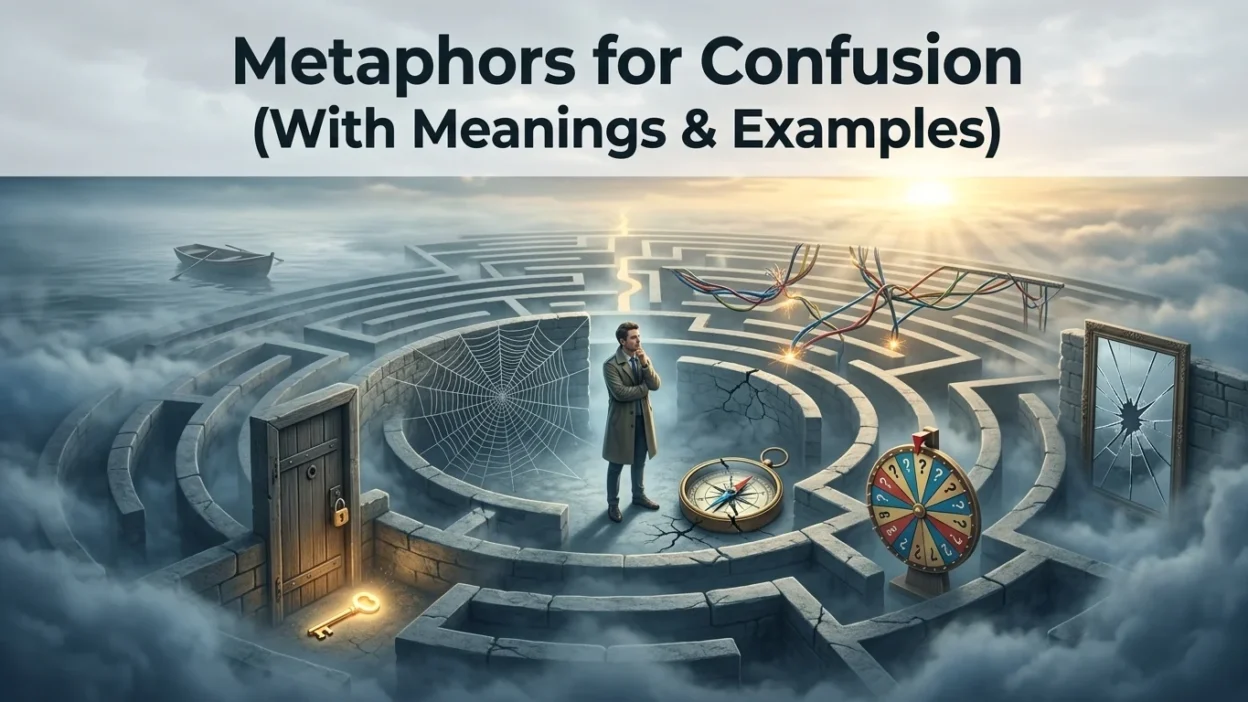
1. My mind is a tangled web.
Meaning: My thoughts are mixed up.
Explanation: A tangled web is difficult to untangle.
Example 1: After the lecture, my mind was a tangled web.
Example 2: The puzzle turned my thoughts into a tangled web.
2. Confusion is a thick fog.
Meaning: It is hard to think clearly.
Explanation: Fog makes it difficult to see ahead.
Example 1: A thick fog filled my thoughts.
Example 2: The truth slowly cleared the fog.
3. My thoughts are a maze.
Meaning: My ideas are difficult to understand.
Explanation: A maze is confusing to navigate.
Example 1: My thoughts became a maze.
Example 2: I searched for the way out.
4. Confusion is a storm.
Meaning: Thoughts feel chaotic.
Explanation: Storms are loud, messy, and unpredictable.
Example 1: A storm raged inside my mind.
Example 2: Calm words settled the storm.
5. My brain is a broken compass.
Meaning: I cannot find the right direction.
Explanation: A broken compass cannot guide you.
Example 1: During the test, my brain was a broken compass.
Example 2: I needed help to find my way.
6. Confusion is a spinning wheel.
Meaning: Thoughts keep going in circles.
Explanation: A spinning wheel never seems to stop.
Example 1: My ideas became a spinning wheel.
Example 2: I couldn’t stop overthinking.
7. My head is a puzzle.
Meaning: My thoughts don’t fit together.
Explanation: A puzzle needs the right pieces.
Example 1: My head was a puzzle without answers.
Example 2: One clue completed the puzzle.
8. Confusion is a dark forest.
Meaning: The situation feels uncertain.
Explanation: A dark forest makes finding the path difficult.
Example 1: I walked through a dark forest of questions.
Example 2: Good advice showed me the path.
9. My thoughts are crossed wires.
Meaning: My thinking is mixed up.
Explanation: Crossed wires cause mistakes.
Example 1: My thoughts were crossed wires today.
Example 2: A short break fixed the problem.
10. Confusion is quicksand.
Meaning: The more you struggle, the harder it becomes.
Explanation: Quicksand traps whatever enters it.
Example 1: I sank into confusion like quicksand.
Example 2: A clear explanation pulled me out.
11. My mind is a cloudy sky.
Meaning: My thinking lacks clarity.
Explanation: Clouds hide the sunshine.
Example 1: My mind became a cloudy sky.
Example 2: The answer cleared the clouds.
12. Confusion is a locked door.
Meaning: Understanding seems blocked.
Explanation: A locked door prevents progress.
Example 1: The problem became a locked door.
Example 2: The teacher handed me the key.
13. My thoughts are a traffic jam.
Meaning: Too many ideas compete for attention.
Explanation: Traffic jams stop movement.
Example 1: My thoughts formed a traffic jam.
Example 2: One decision got everything moving again.
14. Confusion is an unfinished map.
Meaning: The path ahead is unclear.
Explanation: A map without details cannot guide you.
Example 1: My future looked like an unfinished map.
Example 2: Planning completed the map.
15. My brain is a noisy marketplace.
Meaning: Too many thoughts compete at once.
Explanation: Busy markets are full of distractions.
Example 1: My brain became a noisy marketplace.
Example 2: Quiet time calmed the crowd.
16. Confusion is a knot.
Meaning: A problem feels difficult to solve.
Explanation: Knots require patience to untie.
Example 1: The situation became a tight knot.
Example 2: We slowly untied the knot.
17. My thoughts are falling dominoes.
Meaning: One confusing idea leads to another.
Explanation: Dominoes affect each other.
Example 1: My thoughts became falling dominoes.
Example 2: One answer stopped the chain.
18. Confusion is a broken mirror.
Meaning: Understanding is scattered.
Explanation: A broken mirror reflects incomplete images.
Example 1: My understanding became a broken mirror.
Example 2: The explanation put the pieces together.
19. My mind is a drifting boat.
Meaning: My thoughts have no clear direction.
Explanation: A drifting boat moves without control.
Example 1: My mind was a drifting boat.
Example 2: A clear goal guided the boat home.
20. Confusion is a blindfold.
Meaning: I cannot clearly understand the situation.
Explanation: A blindfold limits what you can see.
Example 1: Confusion felt like a blindfold.
Example 2: The facts finally removed it.
Practical Exercise
- What is a metaphor?
- Complete: My mind is a tangled ________.
- Which metaphor represents unclear thinking?
- Which metaphor suggests having no direction?
- What does “Confusion is a thick fog” mean?
- Which metaphor represents too many thoughts?
- Which metaphor compares confusion to being trapped?
- What does “My thoughts are crossed wires” suggest?
- Write your own metaphor for confusion.
- Why do writers use metaphors for confusion?
Answers
- A direct comparison without using “like” or “as.”
- Web.
- My mind is a cloudy sky.
- My brain is a broken compass or my mind is a drifting boat.
- It means it is difficult to think clearly.
- My brain is a noisy marketplace or my thoughts are a traffic jam.
- Confusion is quicksand.
- Thoughts are mixed up or misunderstood.
- Answers will vary.
- They make emotions and ideas easier to imagine and remember.
Conclusion
Metaphors for confusion help writers describe uncertain thoughts in a vivid and meaningful way. Instead of simply saying you feel confused, you can describe your mind as a tangled web, a maze, a broken compass, or a cloudy sky. These examples of metaphors add emotion and clarity to creative writing. Try creating your own metaphors by thinking about what confusion feels like to you. With practice, your stories, poems, and descriptions will become more engaging, expressive, and memorable.