What Are Metaphors for Kids?
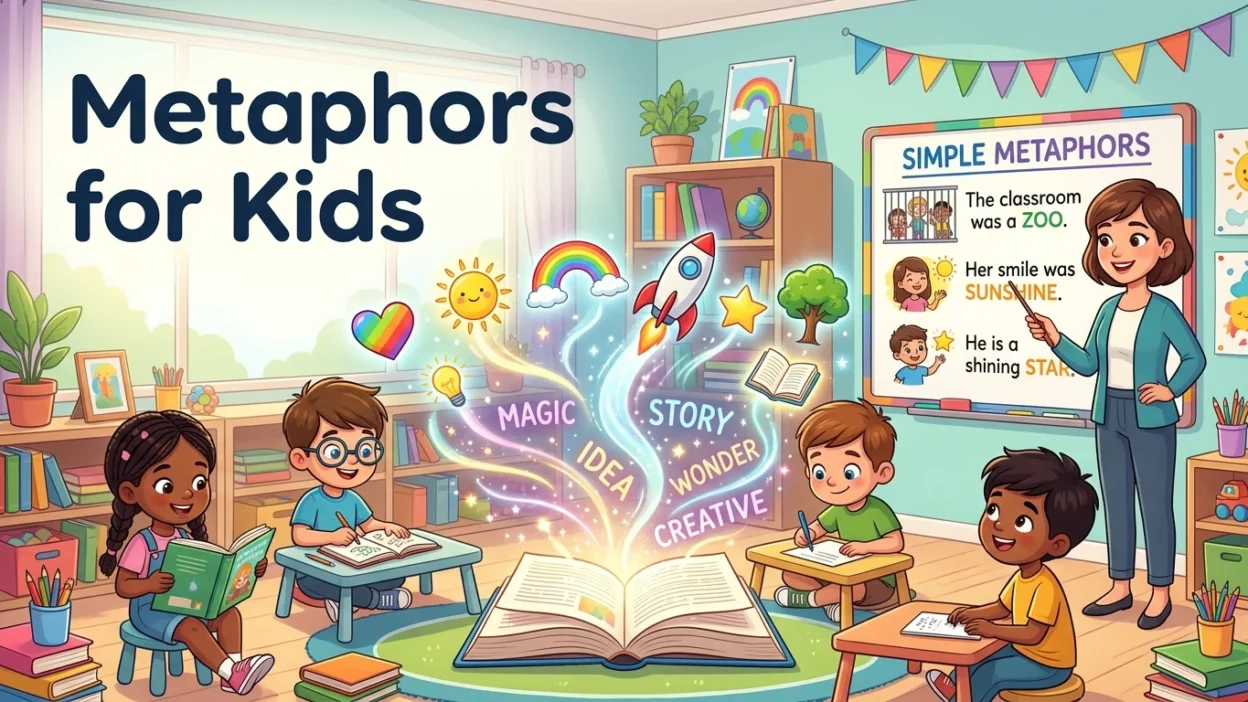
Have you ever said, “My teacher is a sunshine” or “The classroom is a zoo”? If so, you have already used a metaphor! A metaphor compares one thing to another by saying that one thing is another thing. It does not use the words “like” or “as.”
For example, “The moon is a lamp” compares the moon to a lamp because both give off light. Of course, the moon is not really a lamp. The comparison simply helps readers imagine it in a fun way.
Metaphors make writing more colorful and exciting. They help kids describe people, places, feelings, animals, and everyday things with imagination. In simple terms, a metaphor lets you paint a picture with words.
You may also hear the word simile. A simile makes a comparison using “like” or “as,” such as “The moon is like a lamp.” So, let’s explore some easy examples of metaphors and learn how to use metaphors in writing.
20 Easy Metaphors for Kids
1. The classroom is a zoo.
Meaning: The classroom is very noisy or busy.
Explanation: A zoo can have many animals making sounds and moving around. This metaphor compares a noisy classroom to a zoo.
Example 1: The classroom was a zoo before the teacher arrived.
Example 2: After lunch, our classroom became a zoo.
2. My brother is a monkey.
Meaning: My brother acts playful or silly.
Explanation: Monkeys often act energetic and playful, so this metaphor describes someone with similar behavior.
Example 1: My little brother is a monkey at home.
Example 2: That little monkey climbed all over the playground.
3. The sun is a golden ball.
Meaning: The sun looks round and bright.
Explanation: This metaphor compares the round, glowing sun to a golden ball.
Example 1: The sun was a golden ball in the morning sky.
Example 2: A golden ball appeared above the hills.
4. Her smile is sunshine.
Meaning: Her smile brings happiness.
Explanation: Sunshine makes people think of warmth and happiness. This metaphor connects a cheerful smile with sunshine.
Example 1: Her smile is sunshine on a cloudy day.
Example 2: My friend’s smile became sunshine in the room.
5. The snow is a white blanket.
Meaning: Snow covers the ground.
Explanation: A blanket covers a bed, while snow covers the land.
Example 1: The snow was a white blanket over the garden.
Example 2: A white blanket covered the rooftops.
6. My teacher is a walking dictionary.
Meaning: The teacher knows many words and facts.
Explanation: A dictionary contains lots of information. This metaphor shows that the teacher knows a lot.
Example 1: Our English teacher is a walking dictionary.
Example 2: Ask Sara about that word; she is a walking dictionary.
7. The baby is a little angel.
Meaning: The baby behaves sweetly.
Explanation: An angel often represents goodness and kindness.
Example 1: The baby was a little angel during the visit.
Example 2: Everyone called her a little angel.
8. My backpack is a brick.
Meaning: The backpack feels very heavy.
Explanation: A brick has weight, so this metaphor shows that the backpack feels difficult to carry.
Example 1: My backpack is a brick after I fill it with books.
Example 2: His school bag felt like a brick by the end of the day.
9. The wind is a playful dancer.
Meaning: The wind moves around freely.
Explanation: A dancer moves and spins. This metaphor gives the wind human-like movement.
Example 1: The wind was a playful dancer among the trees.
Example 2: A playful dancer moved through the leaves.
10. The stars are diamonds.
Meaning: The stars look bright and beautiful.
Explanation: Diamonds sparkle, and stars can appear to sparkle in the night sky.
Example 1: The stars were diamonds above us.
Example 2: Diamonds filled the dark sky.
11. The ocean is a giant mirror.
Meaning: The ocean reflects light or the sky.
Explanation: Calm water can reflect objects like a mirror.
Example 1: The ocean became a giant mirror at sunset.
Example 2: The giant mirror reflected the orange sky.
12. His voice is thunder.
Meaning: His voice is very loud or powerful.
Explanation: Thunder makes a strong, powerful sound.
Example 1: His voice was thunder across the hall.
Example 2: The coach’s voice became thunder during the game.
13. Her eyes are stars.
Meaning: Her eyes look bright or lively.
Explanation: Stars shine brightly, so this metaphor creates a vivid picture of bright eyes.
Example 1: Her eyes were stars in the soft light.
Example 2: His eyes became stars when he saw the surprise.
14. The playground is a battlefield.
Meaning: The playground is full of energetic competition.
Explanation: A battlefield represents intense action and competition. This metaphor can describe a very competitive game.
Example 1: The soccer field became a battlefield.
Example 2: The playground was a battlefield during the big match.
15. My dad is a rock.
Meaning: My dad is strong and dependable.
Explanation: A rock represents strength and stability.
Example 1: My dad is a rock when I need help.
Example 2: She was a rock for her family.
16. Books are windows.
Meaning: Books help us discover new ideas and worlds.
Explanation: A window lets us see outside. Books can also help us see beyond our everyday experiences.
Example 1: Books are windows into new worlds.
Example 2: Every book became a window to another adventure.
17. The city is a jungle.
Meaning: The city feels crowded, busy, or difficult to navigate.
Explanation: A jungle contains many things happening at once. Writers sometimes use this metaphor to describe a busy city.
Example 1: The city was a jungle of cars and people.
Example 2: After moving downtown, the city felt like a jungle.
18. Her heart is gold.
Meaning: She is very kind and caring.
Explanation: Gold often represents something valuable. This metaphor says that her kindness is precious.
Example 1: My grandmother has a heart of gold.
Example 2: Everyone loves him because his heart is gold.
19. The moon is a night lamp.
Meaning: The moon provides light at night.
Explanation: A lamp gives light in darkness, just as the moon brightens the night sky.
Example 1: The moon was a night lamp above the trees.
Example 2: Our night lamp glowed over the quiet village.
20. Life is a journey.
Meaning: Life includes different stages, choices, and experiences.
Explanation: A journey has a beginning, different paths, challenges, and destinations. Writers use this metaphor to describe how people move through life.
Example 1: Life is a journey filled with lessons.
Example 2: Every new experience became another step on her journey.
Metaphor vs. Simile for Kids
It can feel confusing at first, but here is an easy trick.
A metaphor says one thing is another:
“The moon is a lamp.”
A simile compares two things using “like” or “as”:
“The moon is like a lamp.”
So, if you see like or as, you probably have a simile. If the sentence directly says one thing is another, you probably have a metaphor.
The phrase “strohl simile” does not describe a standard literary term. If you meant “simile,” the simple explanation above will help you tell a simile from a metaphor.
How Metaphors Help Kids Write Better
Metaphors give ordinary sentences more life. Instead of writing, “The boy ran quickly,” you might write, “The boy was a rocket.” The second sentence creates a stronger picture in the reader’s mind.
Metaphors also help kids express feelings. For example, “My worry is a heavy cloud” gives readers an image of a feeling that seems difficult to escape.
In addition, metaphors can make poems, stories, school assignments, and creative writing more interesting. They encourage you to look at ordinary things in new ways.
Practical Exercise: Test Your Metaphor Skills
- What is a metaphor?
- Complete the metaphor: The sun is a ________.
- Which metaphor describes a noisy classroom?
- What does “Her smile is sunshine” mean?
- Which metaphor shows that someone is dependable?
- Complete: The stars are ________.
- Is “The moon is like a lamp” a metaphor or a simile?
- What does “My backpack is a brick” mean?
- Create your own metaphor for a rainy day.
- Create your own metaphor for happiness.
Answers
1. What is a metaphor?
A metaphor directly compares two different things by saying one thing is another.
Example: “The classroom is a zoo.”
2. The sun is a ________.
One possible answer is golden ball.
Explanation: The round, bright sun can look like a golden ball.
3. Which metaphor describes a noisy classroom?
“The classroom is a zoo.”
Explanation: A zoo can be noisy and busy, so the metaphor creates that picture.
4. What does “Her smile is sunshine” mean?
It means her smile brings happiness and warmth.
Explanation: Sunshine often makes us think of warmth and happiness.
5. Which metaphor shows that someone is dependable?
“My dad is a rock.”
Explanation: A rock represents strength and stability.
6. The stars are ________.
Diamonds.
Explanation: Both stars and diamonds can sparkle and shine.
7. Is “The moon is like a lamp” a metaphor or a simile?
It is a simile.
Explanation: The sentence uses the word “like.”
8. What does “My backpack is a brick” mean?
It means the backpack feels very heavy.
Explanation: A brick has weight, so the comparison helps readers imagine a heavy backpack.
9. Create your own metaphor for a rainy day.
Answers will vary.
Example: “The rain is a silver curtain.”
10. Create your own metaphor for happiness.
Answers will vary.
Example: “Happiness is a warm sunrise.”
Conclusion
Metaphors give kids a fun way to make writing more creative, colorful, and memorable. They turn simple ideas into strong pictures that readers can imagine. For example, “The stars are diamonds” sounds more exciting than simply saying, “The stars are bright.” In the same way, “My teacher is a walking dictionary” creates a clear picture of someone who knows many things.
So, start small. Look around your room, classroom, garden, or playground and choose one object. Then ask yourself, “What else does this remind me of?” Try making a direct comparison. With practice, you will discover that metaphors can turn ordinary words into creative writing. Keep experimenting, keep imagining, and most importantly, have fun with your words!

Gabriel Hudson is a skilled language writer and figurative language enthusiast at Metaphorox.com. He specializes in metaphors, similes, and idioms, creating engaging content that helps readers understand creative expressions and communicate more effectively.