Definition
Darkness can represent much more than the absence of light. In writing, it often symbolizes mystery, fear, sadness, uncertainty, or even peace and rest. That is why writers use metaphors for darkness to create strong emotions and vivid images without long explanations.
A metaphor is a direct comparison that does not use “like” or “as.” Instead of saying someone felt confused, you might write, “He was trapped in a maze.” In simple terms, metaphors help readers picture emotions and ideas more clearly. They make poems, stories, speeches, and essays more engaging. Let’s explore 20 examples of metaphors for darkness and learn how to use metaphors in writing.
20 Metaphors for Darkness
1. A black ocean
Meaning: Endless uncertainty.
Explanation: Darkness feels deep and limitless.
Example 1: Fear became a black ocean.
Example 2: She drifted across its waves.
2. A heavy blanket
Meaning: Overwhelming sadness or silence.
Explanation: Darkness covers everything.
Example 1: A heavy blanket settled over the town.
Example 2: Silence wrapped every street.
3. A bottomless pit
Meaning: Deep despair.
Explanation: It feels impossible to escape.
Example 1: His grief was a bottomless pit.
Example 2: Hope seemed far away.
4. A locked door
Meaning: Hidden truth or mystery.
Explanation: Darkness keeps answers unseen.
Example 1: The future was a locked door.
Example 2: No one knew what waited beyond.
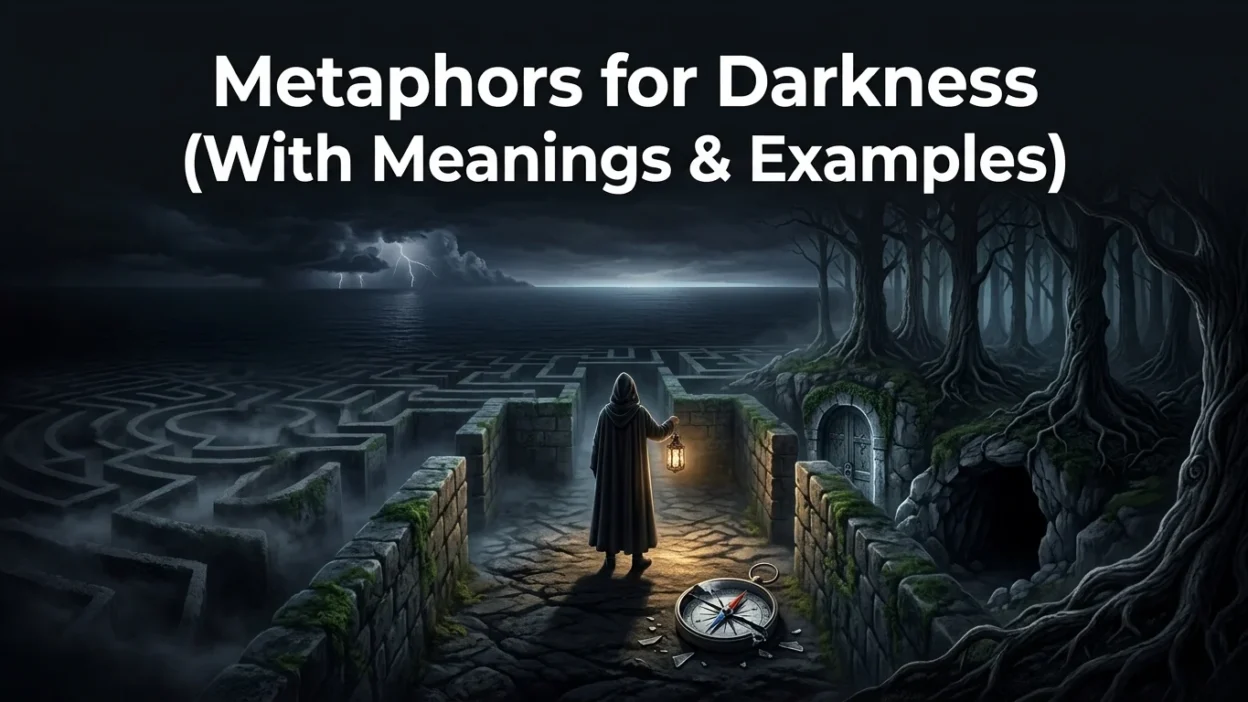
5. A maze
Meaning: Confusion.
Explanation: Darkness makes direction difficult.
Example 1: Her thoughts became a maze.
Example 2: Every choice felt uncertain.
6. A silent cave
Meaning: Loneliness and isolation.
Explanation: Caves are quiet and empty.
Example 1: His heart was a silent cave.
Example 2: Every echo reminded him of solitude.
7. A shadow
Meaning: Fear or hidden trouble.
Explanation: Shadows follow quietly.
Example 1: Doubt became a shadow.
Example 2: It stayed close all day.
8. A storm cloud
Meaning: Trouble approaching.
Explanation: Darkness often signals challenges.
Example 1: Worry became a storm cloud.
Example 2: It hung over every decision.
9. A prison
Meaning: Feeling trapped.
Explanation: Darkness limits freedom.
Example 1: His fear was a prison.
Example 2: He searched for a way out.
10. A sleeping world
Meaning: Quiet and peaceful darkness.
Explanation: Night can bring rest.
Example 1: Darkness became a sleeping world.
Example 2: Everything felt calm.
11. A curtain
Meaning: Hidden reality.
12. A fog
Meaning: Unclear thinking.
13. An endless tunnel
Meaning: Long struggle.
14. A fading candle
Meaning: Losing hope.
15. A forgotten road
Meaning: Isolation.
16. A deep forest
Meaning: Mystery and uncertainty.
17. A closed book
Meaning: Unknown future.
18. A frozen lake
Meaning: Silent emotions.
19. A broken compass
Meaning: Lost direction.
20. A moonless sky
Meaning: Complete darkness and uncertainty.
Practical Exercise
- What is a metaphor?
- Complete: Fear became a ________.
- Which metaphor represents confusion?
- Which metaphor symbolizes despair?
- What does “a shadow” represent?
- Which metaphor means feeling trapped?
- Which metaphor symbolizes mystery?
- Write your own metaphor for darkness.
- Why are metaphors useful in writing?
- Which metaphor best describes uncertainty?
Answers
- A direct comparison without using “like” or “as.”
- Black ocean (or another suitable metaphor).
- A maze.
- A bottomless pit.
- Fear or hidden trouble.
- A prison.
- A locked door or a deep forest.
- Answers will vary.
- They create vivid images and stronger emotions.
- A black ocean, a maze, or a moonless sky.
Conclusion
Metaphors for darkness help writers express emotions, mystery, fear, uncertainty, and even peace with powerful imagery. Instead of describing feelings in plain words, you can compare darkness to a black ocean, a maze, a prison, or a moonless sky to make your writing more memorable. These examples of metaphors make stories, poems, and essays more engaging. Keep practicing your own metaphors to add depth and creativity to every piece of writing.

Michael Luca is a dedicated content writer at Metaphorox.com, specializing in metaphors, similes, and idioms. He develops informative and engaging articles that help readers enhance their language skills and understand figurative expressions more effectively.