Introduction
Grief is one of the deepest emotions people experience. It can come after losing a loved one, saying goodbye to a friend, ending an important chapter in life, or facing any painful change. Because grief is complex, writers often use metaphors for grief to describe feelings that are difficult to express with ordinary words. Instead of simply saying someone feels sad, a metaphor paints a vivid picture that helps readers understand the emotional experience.
For example, instead of writing “She was filled with grief,” you could say, “Grief was a heavy stone on her heart.” Likewise, instead of saying “He couldn’t move on,” you might write, “He wandered through a never-ending winter.” These comparisons make writing more emotional, memorable, and meaningful.
In simple terms, metaphors help readers see and feel emotions through familiar images. Whether you’re writing an essay, poem, speech, or story, learning how to use metaphors in writing can make your message more powerful. So, let’s explore 20 metaphors for grief, understand their meanings, read examples of metaphors, and practice creating your own.
What Is a Metaphor?
A metaphor is a figure of speech that directly compares one thing to another without using like or as.
Example
Grief is a heavy stone.
This doesn’t mean grief is literally a rock. Instead, it shows that grief can feel emotionally heavy and difficult to carry.
The meaning of metaphors is to explain emotions and ideas through creative, memorable comparisons.
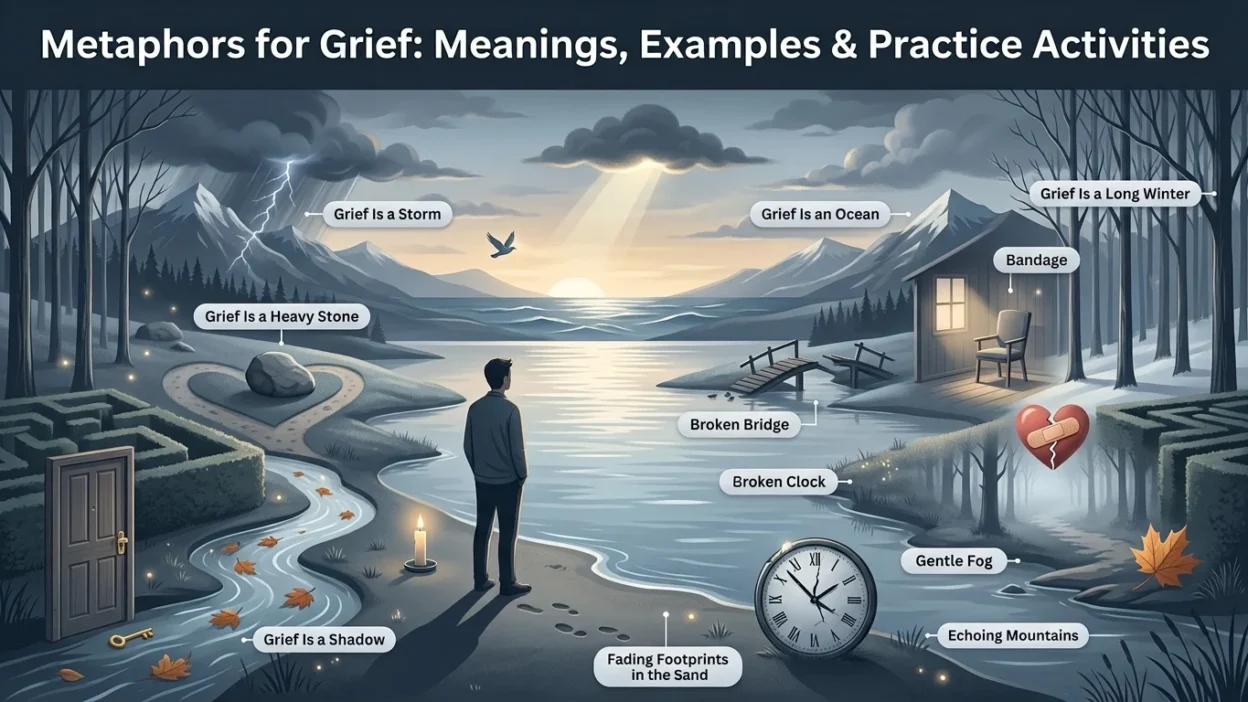
20 Metaphors for Grief
1. Grief Is a Heavy Stone
Meaning: Grief feels difficult to carry.
Explanation: A heavy stone represents emotional weight.
Example Sentences:
- Grief became a heavy stone on her heart.
- He carried that stone every day.
2. Grief Is a Storm
Meaning: Grief arrives with overwhelming emotions.
Explanation: Storms are powerful and unpredictable.
Example Sentences:
- Grief swept through her life like a storm.
- The storm changed everything.
3. Grief Is a Long Winter
Meaning: Grief can feel cold and endless.
Explanation: Winter often symbolizes hardship.
Example Sentences:
- He walked through a long winter.
- Grief made every day feel cold.
4. Grief Is a Shadow
Meaning: Grief quietly follows a person.
Explanation: Shadows remain close.
Example Sentences:
- Grief became her shadow.
- The shadow stayed beside him.
5. Grief Is an Ocean
Meaning: Grief feels deep and overwhelming.
Explanation: Oceans symbolize great depth.
Example Sentences:
- She drifted across an ocean of grief.
- The waves never seemed to end.
6. Grief Is a Broken Bridge
Meaning: Grief changes life’s path.
Explanation: A broken bridge blocks progress.
Example Sentences:
- Grief became a broken bridge.
- He searched for another way forward.
7. Grief Is a Dark Cloud
Meaning: Grief covers happiness.
Explanation: Clouds hide the sun.
Example Sentences:
- A dark cloud settled over her days.
- Grief blocked every ray of hope.
8. Grief Is an Empty Room
Meaning: Grief creates a feeling of absence.
Explanation: Empty rooms remind us of loss.
Example Sentences:
- His heart became an empty room.
- Silence filled the room with grief.
9. Grief Is a Wound
Meaning: Grief causes emotional pain.
Explanation: Wounds need time to heal.
Example Sentences:
- Grief remained an open wound.
- Time slowly helped the wound heal.
10. Grief Is a Maze
Meaning: Grief feels confusing.
Explanation: Mazes are difficult to navigate.
Example Sentences:
- She wandered through a maze of grief.
- Every turn brought new emotions.
11. Grief Is a River
Meaning: Grief continues to flow.
Explanation: Emotions change over time.
Example Sentences:
- Grief flowed through his memories.
- The river carried both tears and hope.
12. Grief Is a Silent Guest
Meaning: Grief quietly remains.
Explanation: It stays without invitation.
Example Sentences:
- Grief became a silent guest.
- It never truly left.
13. Grief Is a Mountain
Meaning: Grief feels enormous.
Explanation: Mountains are difficult to climb.
Example Sentences:
- She faced a mountain of grief.
- Every step required courage.
14. Grief Is a Candle
Meaning: Grief keeps memories alive.
Explanation: A candle symbolizes remembrance.
Example Sentences:
- His love remained a candle.
- The candle glowed through the darkness.
15. Grief Is a Locked Door
Meaning: Grief can make it hard to move forward.
Explanation: Locked doors block progress.
Example Sentences:
- Grief became a locked door.
- Healing slowly found the key.
16. Grief Is a Broken Clock
Meaning: Time feels different during grief.
Explanation: Pain can make time seem frozen.
Example Sentences:
- Time became a broken clock.
- Every hour felt endless.
17. Grief Is a Fog
Meaning: Grief clouds clear thinking.
Explanation: Fog limits vision.
Example Sentences:
- Grief surrounded her like fog.
- It became difficult to see ahead.
18. Grief Is an Echo
Meaning: Memories continue to return.
Explanation: Echoes repeat over time.
Example Sentences:
- His laughter became an echo.
- Every memory echoed through her heart.
19. Grief Is a Falling Leaf
Meaning: Grief reminds us that life changes.
Explanation: Falling leaves symbolize endings.
Example Sentences:
- Grief became a falling leaf.
- Every season carried memories.
20. Grief Is a Quiet Riverbank
Meaning: Grief invites reflection.
Explanation: Calm places encourage remembrance.
Example Sentences:
- She found peace on grief’s quiet riverbank.
- Reflection slowly brought healing.
Practical Exercise
Questions
- Complete the metaphor: Grief is a heavy ______.
- Which metaphor represents emotional confusion?
- What does Grief Is a Storm mean?
- Complete the metaphor: Grief is a dark ______.
- Which metaphor symbolizes deep emotions?
- What does Grief Is a Broken Clock suggest?
- Complete the metaphor: Grief is a falling ______.
- Which metaphor represents emotional weight?
- What does Grief Is an Echo symbolize?
- Which metaphor shows that grief can block progress?
Answers and Explanations
1. Stone – Grief feels heavy to carry.
2. A Maze – Grief can feel confusing and uncertain.
3. Grief can be overwhelming – It arrives with powerful emotions.
4. Cloud – Grief may cover joy and hope.
5. An Ocean – It represents emotional depth.
6. Time feels frozen or slower – Grief changes how we experience time.
7. Leaf – It symbolizes change and loss.
8. A Heavy Stone – Emotional pain can feel like carrying a heavy weight.
9. Memories continue to return – Echoes remind us of what we’ve lost.
10. A Broken Bridge – Grief may interrupt life’s normal path.
How to Create Your Own Metaphors
Writing your own metaphors is easier than you might think.
1: First, think about one feeling grief creates, such as heaviness, loneliness, or confusion.
2: Next, choose an object or image that shares that quality.
3: Then, compare them directly without using like or as.
Examples
- Grief is an unopened letter.
- Grief is a fading sunset.
- Grief is a quiet forest.
As you continue practicing, you’ll naturally create stronger creative writing metaphors. Moreover, your essays, stories, poems, and speeches will become more emotional and engaging.
Conclusion
Metaphors for grief help writers express loss, sadness, remembrance, and healing through vivid imagery. Instead of relying on simple descriptions, you can use creative comparisons that allow readers to connect with emotions more deeply. Throughout this guide, you’ve explored examples of metaphors, learned the meaning of metaphors, and discovered how to use metaphors in writing with clear explanations and practical exercises.
Now it’s your turn. Think about an emotion or memory and create your own original metaphor. The more you practice, the more naturally you’ll write with creativity, emotion, and confidence.