Introduction
Failure is something everyone experiences. You might fail a test, lose a game, miss a goal, or make a mistake at work. Although failure can feel discouraging, it often teaches valuable lessons and helps us grow stronger. Instead of simply saying someone “failed,” writers often use metaphors to describe failure in a more vivid and meaningful way. A metaphor compares one thing to another without using the words like or as. As a result, it helps readers understand emotions and experiences more deeply.
For example, instead of writing, “His plan failed,” you could write, “His plan hit a brick wall.” This metaphor instantly creates a clear mental picture. Likewise, you might say, “Failure was a stepping stone,” showing that setbacks can lead to future success. These creative comparisons make writing more engaging and memorable.
In simple terms, metaphors help explain failure in ways that readers can easily imagine. Whether you’re writing an essay, story, speech, or poem, learning how to use metaphors in writing will make your work stronger. So, let’s explore 20 metaphors for failure, discover their meanings, read practical examples of metaphors, and practice using them with confidence.
What Is a Metaphor?
A metaphor is a figure of speech that directly compares one thing to another without using like or as.
Example
Failure is a stepping stone.
This doesn’t mean failure is literally a stone. Instead, it means setbacks can help you move toward success.
The meaning of metaphors is to express ideas through creative comparisons that make writing more vivid and powerful.
20 Metaphors for Failure
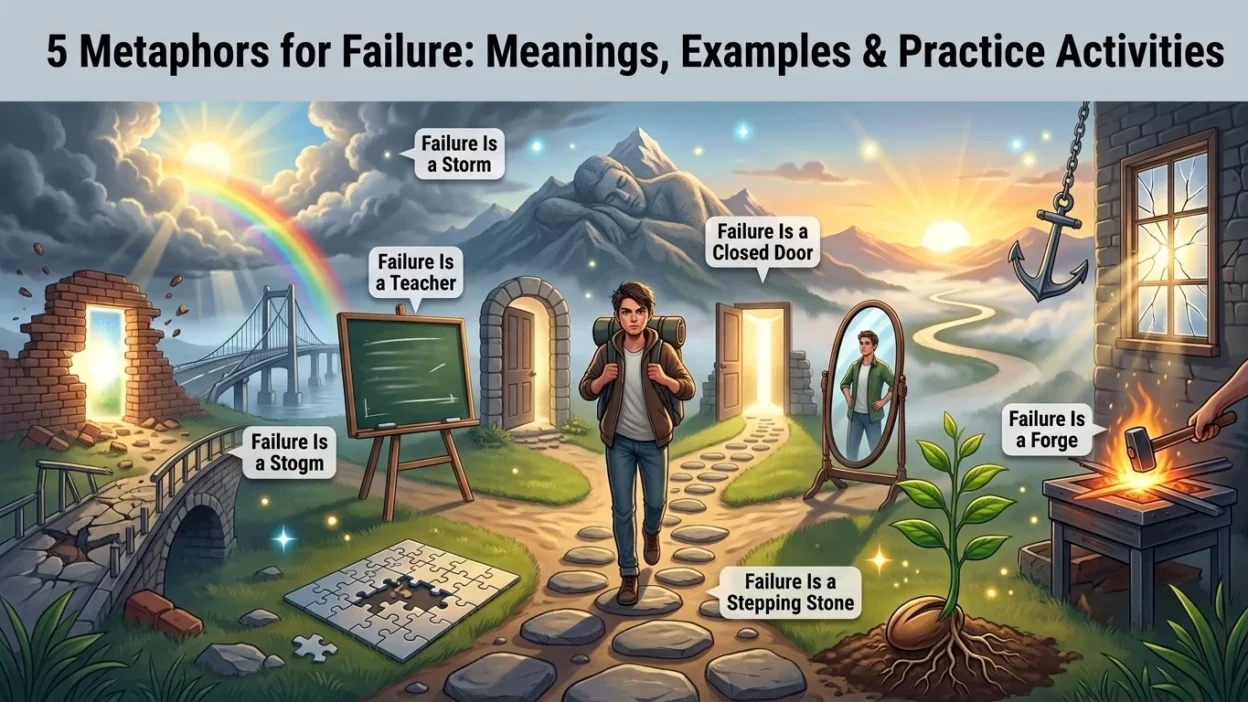
1. Failure Is a Stepping Stone
Meaning: Failure leads to future success.
Explanation: Every setback helps you move forward.
Example Sentences:
- Failure is a stepping stone to success.
- Every mistake became another stepping stone.
2. Failure Is a Brick Wall
Meaning: Progress suddenly stops.
Explanation: A brick wall blocks your path.
Example Sentences:
- His project hit a brick wall.
- We finally found a way around the wall.
3. Failure Is a Detour
Meaning: Failure changes your path but doesn’t end the journey.
Explanation: Detours lead to new routes.
Example Sentences:
- Failure became a detour.
- The detour led to a better opportunity.
4. Failure Is a Storm
Meaning: Failure brings temporary challenges.
Explanation: Storms eventually pass.
Example Sentences:
- Failure was a storm in her life.
- The storm made him stronger.
5. Failure Is a Broken Bridge
Meaning: One path no longer works.
Explanation: A broken bridge forces you to find another route.
Example Sentences:
- Failure became a broken bridge.
- They built a stronger bridge afterward.
6. Failure Is a Teacher
Meaning: Failure teaches valuable lessons.
Explanation: Every mistake offers knowledge.
Example Sentences:
- Failure is the best teacher.
- Every lesson came from that teacher.
7. Failure Is a Puzzle
Meaning: Problems require patience to solve.
Explanation: Every puzzle has a solution.
Example Sentences:
- Failure became a puzzle.
- She solved each piece with determination.
8. Failure Is a Closed Door
Meaning: One opportunity ends.
Explanation: Another door may open later.
Example Sentences:
- Failure was a closed door.
- Soon another door opened.
9. Failure Is a Shadow
Meaning: Failure may follow you for a while.
Explanation: Shadows disappear when light returns.
Example Sentences:
- Failure became a shadow.
- Success eventually replaced the shadow.
10. Failure Is a Seed
Meaning: Failure can grow into future success.
Explanation: Seeds develop with time and care.
Example Sentences:
- Failure planted a seed of wisdom.
- That seed grew into confidence.
11. Failure Is a Mountain
Meaning: Failure feels difficult to overcome.
Explanation: Mountains require effort to climb.
Example Sentences:
- Failure became a mountain.
- Persistence helped him reach the top.
12. Failure Is a Mirror
Meaning: Failure reveals your weaknesses.
Explanation: Mirrors reflect reality.
Example Sentences:
- Failure became a mirror.
- The reflection inspired improvement.
13. Failure Is a Fog
Meaning: Failure creates uncertainty.
Explanation: Fog makes it hard to see ahead.
Example Sentences:
- Failure covered the future with fog.
- Hope cleared the fog.
14. Failure Is an Anchor
Meaning: Failure can hold you back if you let it.
Explanation: Anchors stop movement.
Example Sentences:
- Fear turned failure into an anchor.
- Confidence lifted the anchor.
15. Failure Is a Crossroad
Meaning: Failure forces an important decision.
Explanation: Crossroads offer different directions.
Example Sentences:
- Failure became a crossroad.
- She chose a better path.
16. Failure Is a Cracked Window
Meaning: Your view changes after disappointment.
Explanation: Cracks distort what you see.
Example Sentences:
- Failure became a cracked window.
- Optimism repaired the view.
17. Failure Is a Sleeping Giant
Meaning: Failure can become a bigger problem if ignored.
Explanation: Giants are powerful once awakened.
Example Sentences:
- His mistake became a sleeping giant.
- He solved the problem before it grew.
18. Failure Is a Heavy Backpack
Meaning: Failure can feel like a burden.
Explanation: Heavy backpacks slow your progress.
Example Sentences:
- Failure became a heavy backpack.
- She kept walking despite the weight.
19. Failure Is a Bend in the Road
Meaning: Failure changes direction but doesn’t end the journey.
Explanation: Roads continue after bends.
Example Sentences:
- Failure was only a bend in the road.
- They continued with confidence.
20. Failure Is a Forge
Meaning: Failure builds strength and character.
Explanation: A forge shapes metal through heat.
Example Sentences:
- Failure became a forge.
- Every challenge made him stronger.
Practical Exercise
Questions
- Complete the metaphor: Failure is a stepping ______.
- Which metaphor represents a temporary challenge?
- What does failure is a teacher mean?
- Complete the metaphor: Failure is a closed ______.
- Which metaphor symbolizes a new direction?
- What does failure is a seed suggest?
- Complete the metaphor: Failure is a heavy ______.
- Which metaphor represents uncertainty?
- What does failure is a forge symbolize?
- Which metaphor means failure is not the end of the journey?
Answers and Explanations
1. Stone – Failure can lead to success.
2. A Storm – Challenges eventually pass.
3. Failure teaches valuable lessons – Mistakes help people improve.
4. Door – One opportunity closes before another opens.
5. A Crossroad – Failure can lead to better choices.
6. It can grow into success – Lessons become future achievements.
7. Backpack – Failure can feel like a burden.
8. A Fog – It represents confusion and uncertainty.
9. It builds strength – Challenges shape character over time.
10. A Bend in the Road – Failure changes direction but doesn’t stop progress.
How to Create Your Own Metaphors
Creating metaphors is easier than you might think.
1: First, think about how failure feels.
2: Next, choose an object, place, or event with similar qualities.
3: Then, write that failure is the object without using like or as.
Examples
- Failure is a staircase to wisdom.
- Failure is an unfinished map.
- Failure is a training ground.
The more you practice, the more naturally you’ll use creative writing metaphors. Consequently, your writing will become clearer, stronger, and more memorable.
Conclusion
Metaphors help you describe failure in ways that inspire understanding rather than discouragement. Instead of simply focusing on setbacks, they show how challenges can teach lessons, build character, and create new opportunities. Throughout this guide, you’ve explored examples of metaphors, learned the meaning of metaphors, and practiced using them in different situations.
Now it’s your turn. Think about a challenge you’ve faced and create an original metaphor that describes what you learned from it. With regular practice, you’ll master how to use metaphors in writing and create essays, stories, and speeches that connect with readers on a deeper level.

Michael Luca is a dedicated content writer at Metaphorox.com, specializing in metaphors, similes, and idioms. He develops informative and engaging articles that help readers enhance their language skills and understand figurative expressions more effectively.