Introduction
Guilt is a powerful emotion that almost everyone experiences at some point. You may feel guilty after making a mistake, hurting someone’s feelings, or missing an important opportunity. However, simply saying “I feel guilty” doesn’t always capture the weight of that emotion. That’s why writers often use metaphors for guilt. These creative comparisons help readers see and feel guilt in a much stronger way.
For example, instead of saying “He felt guilty,” you might write “He carried a heavy chain around his heart.” Immediately, readers understand how difficult that feeling is. Likewise, instead of saying “She couldn’t forget her mistake,” you could write “Her guilt was a shadow that followed every step.” These images make writing more vivid and memorable.
In simple terms, a metaphor compares two unlike things without using like or as. As a result, metaphors make emotions easier to understand and more interesting to read. Whether you’re writing an essay, poem, speech, or story, learning how to use metaphors in writing will strengthen your creative skills. So, let’s explore 20 metaphors for guilt, discover their meanings, read practical examples of metaphors, and practice using them yourself.
What Is a Metaphor?
A metaphor is a figure of speech that directly compares one thing to another without using like or as.
Example
Guilt is a heavy chain.
This doesn’t mean guilt is literally a chain. Instead, it suggests that guilt can weigh a person down and make it difficult to move forward.
The meaning of metaphors is to express ideas through imaginative comparisons that create vivid mental images.
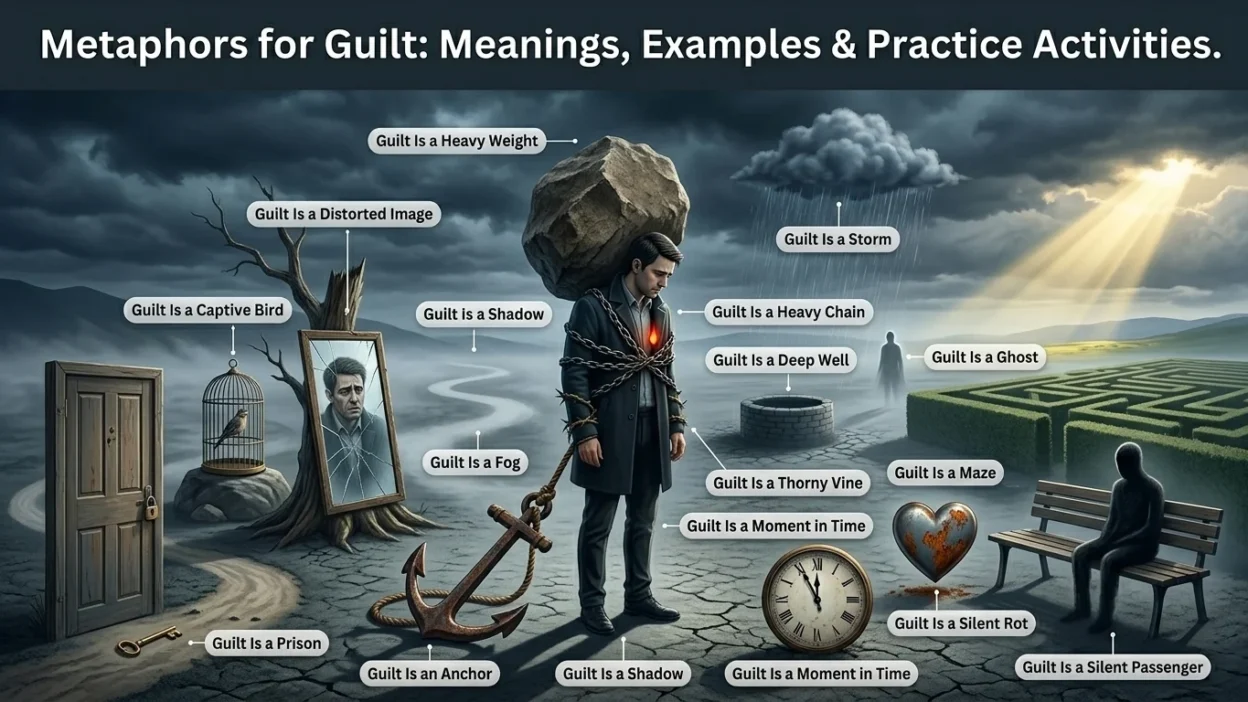
20 Metaphors for Guilt
1. Guilt Is a Heavy Chain
Meaning: Guilt feels difficult to carry.
Explanation: Like a chain, guilt can slow a person down.
Example Sentences:
- He carried a heavy chain after breaking his promise.
- Her guilt became a heavy chain around her heart.
2. Guilt Is a Shadow
Meaning: Guilt follows someone everywhere.
Explanation: A shadow stays close and is hard to escape.
Example Sentences:
- His guilt followed him like a shadow.
- The shadow never left her thoughts.
3. Guilt Is a Storm
Meaning: Guilt creates emotional turmoil.
Explanation: Storms are powerful and overwhelming.
Example Sentences:
- A storm raged inside his mind.
- Her guilt became a storm that wouldn’t calm.
4. Guilt Is a Prison
Meaning: Guilt makes people feel trapped.
Explanation: It limits emotional freedom.
Example Sentences:
- He lived inside a prison of regret.
- Guilt locked every happy memory away.
5. Guilt Is a Stone
Meaning: Guilt feels heavy.
Explanation: Stones represent emotional weight.
Example Sentences:
- A stone rested on her heart.
- His guilt became impossible to lift.
6. Guilt Is a Thorn
Meaning: Guilt causes constant emotional pain.
Explanation: Thorns keep hurting until removed.
Example Sentences:
- The thorn stayed in his heart.
- Guilt pricked her every day.
7. Guilt Is a Dark Cloud
Meaning: Guilt overshadows happiness.
Explanation: Clouds block sunlight.
Example Sentences:
- A dark cloud hung over him.
- Guilt covered every joyful moment.
8. Guilt Is an Anchor
Meaning: Guilt prevents progress.
Explanation: Anchors keep ships from moving.
Example Sentences:
- His guilt became an anchor.
- She couldn’t move beyond the mistake.
9. Guilt Is a Fire
Meaning: Guilt burns emotionally.
Explanation: Fire symbolizes emotional pain.
Example Sentences:
- Guilt burned inside him.
- The fire grew with every memory.
10. Guilt Is a Mirror
Meaning: Guilt forces self-reflection.
Explanation: Mirrors reveal what we see in ourselves.
Example Sentences:
- Every memory became a mirror.
- He faced his mistakes honestly.
11. Guilt Is a Cage
Meaning: Guilt limits freedom.
Explanation: A cage traps what is inside.
Example Sentences:
- Guilt became a cage.
- She finally opened the cage through forgiveness.
12. Guilt Is a Backpack Full of Rocks
Meaning: Guilt becomes harder to carry over time.
Explanation: Heavy loads slow every step.
Example Sentences:
- He carried years of guilt.
- Every mistake added another rock.
13. Guilt Is a Ghost
Meaning: Old guilt keeps returning.
Explanation: Ghosts symbolize lingering memories.
Example Sentences:
- The ghost visited every quiet night.
- Guilt haunted his thoughts.
14. Guilt Is a Maze
Meaning: Guilt creates confusion.
Explanation: Mazes make finding a way out difficult.
Example Sentences:
- She wandered through a maze of guilt.
- Every decision became harder.
15. Guilt Is a Locked Door
Meaning: Guilt blocks healing.
Explanation: Locked doors prevent progress.
Example Sentences:
- Guilt closed every door.
- Forgiveness became the key.
16. Guilt Is a Broken Clock
Meaning: Guilt keeps someone stuck in the past.
Explanation: A broken clock never moves forward.
Example Sentences:
- His thoughts became a broken clock.
- She replayed the same mistake repeatedly.
17. Guilt Is Thick Fog
Meaning: Guilt clouds judgment.
Explanation: Fog makes it difficult to see clearly.
Example Sentences:
- Thick fog covered his mind.
- Guilt blurred every decision.
18. Guilt Is a Deep Well
Meaning: Guilt feels difficult to escape.
Explanation: Wells are deep and hard to climb out of.
Example Sentences:
- She fell into a deep well.
- Hope slowly helped her climb out.
19. Guilt Is Rust
Meaning: Guilt slowly damages peace of mind.
Explanation: Rust weakens metal over time.
Example Sentences:
- Guilt rusted his confidence.
- Forgiveness cleaned away the rust.
20. Guilt Is a Silent Passenger
Meaning: Guilt stays present even during everyday life.
Explanation: It quietly travels with a person.
Example Sentences:
- Guilt rode beside him.
- The silent passenger stayed until he apologized.
Practical Exercise
Questions
- Complete the metaphor: Guilt is a ______.
- Which metaphor represents emotional weight?
- What does Guilt Is an Anchor mean?
- Complete the metaphor: Guilt is a ______ that follows every step.
- Which metaphor represents emotional pain?
- What does Guilt Is a Prison suggest?
- Complete the metaphor: Guilt is a ______ that clouds judgment.
- Which metaphor symbolizes being trapped by emotions?
- What does Guilt Is Rust represent?
- Which metaphor suggests healing requires forgiveness?
Answers and Explanations
1. Heavy Chain – Guilt feels difficult to carry.
2. Stone – It represents emotional heaviness.
3. It prevents progress – Like an anchor holding a ship still.
4. Shadow – Guilt often stays with someone.
5. Fire – It symbolizes emotional burning.
6. Guilt makes people feel trapped – It limits emotional freedom.
7. Thick Fog – Guilt makes clear thinking harder.
8. Cage – It represents emotional imprisonment.
9. Guilt slowly damages inner peace – Just as rust weakens metal.
10. Locked Door – Forgiveness becomes the key that opens the door.
How to Create Your Own Metaphors
Writing your own metaphors is easier than you might expect.
First, identify the feeling you want to describe. Next, think of an object, place, or experience that shares similar qualities. Then, connect them without using like or as.
For example:
- Guilt is an unfinished letter.
- Guilt is a cracked window.
- Guilt is a fading echo.
As you continue practicing, you’ll naturally develop stronger creative writing metaphors. Moreover, your essays, poems, speeches, and stories will become more emotional, descriptive, and memorable.
Conclusion
Metaphors for guilt help writers express difficult emotions through vivid and meaningful comparisons. Instead of simply saying someone feels guilty, you can paint a clear picture that readers immediately understand. Throughout this guide, you’ve explored examples of metaphors, learned the meaning of metaphors, and discovered how to use metaphors in writing with practical explanations and exercises.
Now it’s your turn. Think about an experience involving guilt and create your own metaphor. With regular practice, you’ll write with greater emotion, creativity, and confidence while making your ideas unforgettable.

Michael Luca is a dedicated content writer at Metaphorox.com, specializing in metaphors, similes, and idioms. He develops informative and engaging articles that help readers enhance their language skills and understand figurative expressions more effectively.