Introduction
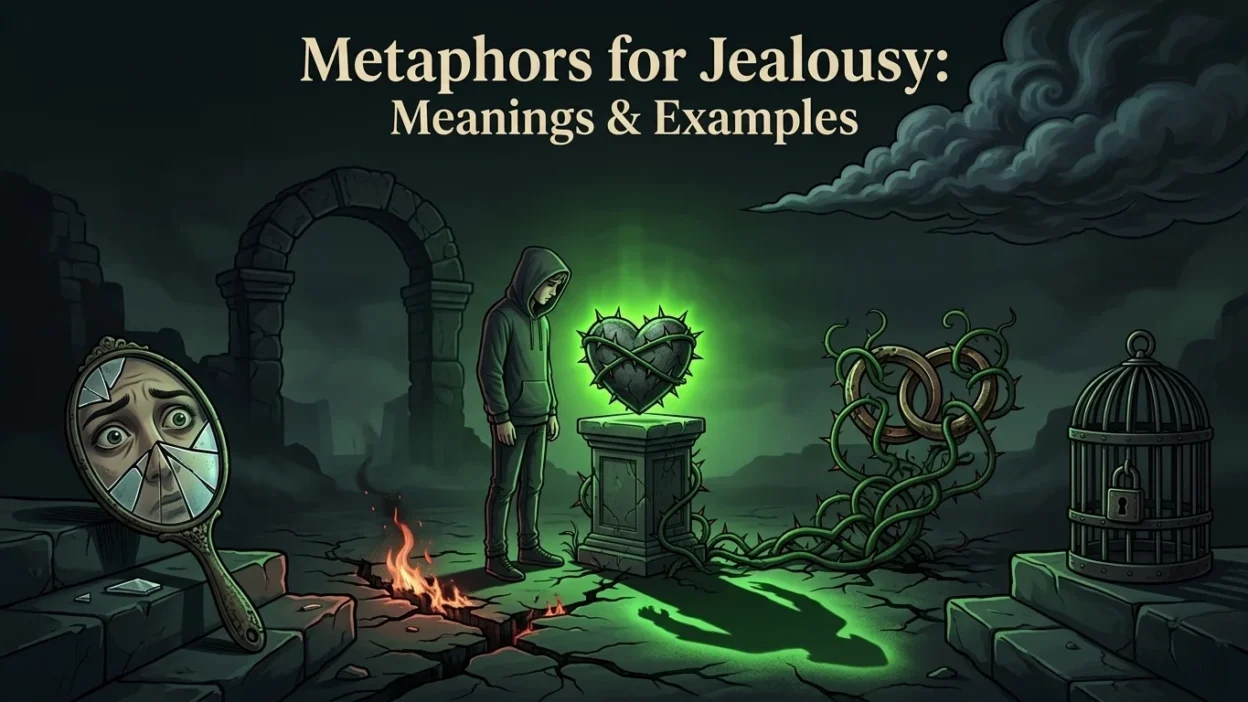
Jealousy can feel difficult to explain. It may begin as a small worry, grow into doubt, or become a strong emotion that changes how someone thinks and acts. That’s why writers often use metaphors for jealousy to make this emotion easier to picture. Instead of simply saying, “He felt jealous,” you can create a vivid image that shows exactly how jealousy affects him. For example, you might write, “Jealousy was a green shadow following him everywhere.” Suddenly, the reader can imagine an emotion that refuses to disappear.
In simple terms, metaphors compare one thing directly to another without using like or as. They make emotions feel more real and help readers connect with characters. Moreover, strong metaphors can make stories, poems, essays, and speeches much more memorable. If you’re learning how to use metaphors in writing, emotions such as jealousy offer many creative possibilities. So, let’s explore 20 examples of metaphors for jealousy, understand their meanings, and practice creating your own creative comparisons.
What Is a Metaphor?
A metaphor is a figure of speech that directly compares one thing to another without using like or as.
Example
Jealousy is a green monster.
This does not mean jealousy is literally a monster. Instead, the metaphor suggests that jealousy can grow powerful, frightening, and difficult to control.
The meaning of metaphors becomes clear through the qualities shared by the two things being compared.
20 Metaphors for Jealousy
1. Jealousy Is a Green Monster
Meaning: Jealousy can become powerful and difficult to control.
Explanation: The monster represents an emotion that grows stronger and affects behavior.
Example Sentences:
- The green monster entered his thoughts whenever his friend succeeded.
- Jealousy became a green monster that clouded her judgment.
2. Jealousy Is a Shadow
Meaning: Jealousy follows someone wherever they go.
Explanation: A shadow stays close and can be difficult to escape.
Example Sentences:
- Jealousy was a shadow following him through every conversation.
- Her jealousy became a dark shadow over their friendship.
3. Jealousy Is a Fire
Meaning: Jealousy can grow stronger and consume attention.
Explanation: Fire spreads when people continue to feed it.
Example Sentences:
- Jealousy was a fire burning inside him.
- Every rumor added fuel to the fire of jealousy.
4. Jealousy Is Poison
Meaning: Jealousy can damage relationships.
Explanation: Poison harms from within, just as unchecked jealousy can harm trust.
Example Sentences:
- Jealousy became poison in their friendship.
- His constant suspicion filled the relationship with poison.
5. Jealousy Is a Storm
Meaning: Jealousy creates emotional confusion.
Explanation: A storm can bring strong winds and dark skies, much like intense emotions.
Example Sentences:
- A storm of jealousy filled her mind.
- His thoughts became a storm whenever he felt left out.
6. Jealousy Is a Cage
Meaning: Jealousy can trap a person in negative thoughts.
Explanation: A cage limits freedom.
Example Sentences:
- Jealousy became a cage around his thoughts.
- She felt trapped inside a cage of suspicion.
7. Jealousy Is a Thorn
Meaning: Jealousy causes emotional pain.
Explanation: A thorn can hurt even when it seems small.
Example Sentences:
- Jealousy was a thorn in their friendship.
- One jealous thought became a thorn that would not leave her mind.
8. Jealousy Is a Dark Cloud
Meaning: Jealousy can make everything seem negative.
Explanation: A dark cloud blocks sunlight and creates a gloomy atmosphere.
Example Sentences:
- Jealousy became a dark cloud over his happiness.
- A cloud of jealousy followed their success.
9. Jealousy Is a Hungry Wolf
Meaning: Jealousy can constantly demand more attention.
Explanation: A hungry wolf represents an emotion that keeps searching for something to satisfy it.
Example Sentences:
- Jealousy was a hungry wolf inside his thoughts.
- Her doubts fed the hungry wolf of jealousy.
10. Jealousy Is a Whisper
Meaning: Jealousy can begin quietly.
Explanation: A whisper starts softly but can influence what someone hears and believes.
Example Sentences:
- Jealousy began as a whisper in her mind.
- That small whisper eventually became a loud doubt.
11. Jealousy Is a Mirror
Meaning: Jealousy can reveal personal insecurity.
Explanation: A mirror reflects what is already there.
Example Sentences:
- Jealousy became a mirror of his hidden fears.
- Her jealousy showed her a mirror of her own doubts.
12. Jealousy Is a Leash
Meaning: Jealousy can restrict someone’s thoughts or actions.
Explanation: A leash limits movement.
Example Sentences:
- Jealousy became a leash around his confidence.
- Her fear acted as a leash on her happiness.
13. Jealousy Is a Weed
Meaning: Jealousy can grow quickly if ignored.
Explanation: Weeds spread when people do not remove them.
Example Sentences:
- Jealousy was a weed growing in their friendship.
- One small doubt became a weed of suspicion.
14. Jealousy Is a Locked Door
Meaning: Jealousy can block trust and communication.
Explanation: A locked door prevents people from moving forward.
Example Sentences:
- Jealousy became a locked door between them.
- His suspicion built a locked door around his heart.
15. Jealousy Is an Alarm
Meaning: Jealousy can signal worry or insecurity.
Explanation: An alarm warns us that something may need attention.
Example Sentences:
- Jealousy was an alarm reminding her to examine her fears.
- His jealousy sounded an alarm in his mind.
16. Jealousy Is a Chain
Meaning: Jealousy can hold someone back.
Explanation: Chains represent restriction and emotional weight.
Example Sentences:
- Jealousy became a chain around his peace of mind.
- She broke the chain by choosing trust.
17. Jealousy Is a Fog
Meaning: Jealousy can make clear thinking difficult.
Explanation: Fog hides the path and makes it harder to see clearly.
Example Sentences:
- Jealousy was a fog covering his better judgment.
- A thick fog of jealousy filled her thoughts.
18. Jealousy Is a Seed
Meaning: A small jealous thought can grow into a larger problem.
Explanation: Seeds develop gradually when they receive the right conditions.
Example Sentences:
- One doubt planted a seed of jealousy.
- The seed grew whenever he compared himself with others.
19. Jealousy Is a Leaking Bucket
Meaning: Jealousy can drain happiness and trust.
Explanation: A leaking bucket slowly loses what it holds.
Example Sentences:
- Jealousy was a leaking bucket draining their happiness.
- Constant comparisons turned her confidence into a leaking bucket.
20. Jealousy Is an Echo
Meaning: Jealous thoughts can repeat again and again.
Explanation: An echo repeats a sound, just as jealousy can repeat old doubts.
Example Sentences:
- Jealousy was an echo repeating the same question in his mind.
- Every comparison created another echo of doubt.
Practical Exercise
Questions
- Complete the metaphor: Jealousy is a green ______.
- Which metaphor shows that jealousy follows someone?
- What does Jealousy Is Poison mean?
- Complete the metaphor: Jealousy is a dark ______.
- Which metaphor represents emotional restriction?
- What does Jealousy Is a Seed suggest?
- Complete the metaphor: Jealousy is a ______ covering clear thought.
- Which metaphor represents emotional pain?
- What does Jealousy Is an Echo mean?
- Which metaphor suggests that jealousy can reveal insecurity?
Answers and Explanations
1. Monster – The green monster represents powerful jealousy.
2. A Shadow – A shadow stays close and follows someone.
3. Jealousy can damage relationships – Poison represents something harmful.
4. Cloud – A dark cloud represents negative thoughts and emotions.
5. A Cage, Leash, or Chain – Each represents restriction.
6. A small jealous thought can grow – A seed develops into something larger.
7. Fog – Fog makes it difficult to see clearly.
8. A Thorn – A thorn represents emotional pain.
9. Jealous thoughts can repeat – An echo repeats a sound, just as doubts can repeat in the mind.
10. A Mirror – A mirror represents self-reflection and can reveal hidden fears.
How to Create Your Own Metaphors for Jealousy
Creating your own metaphors becomes easier when you focus on the feeling you want to describe.
1: First, identify what jealousy does. Does it grow, hurt, trap, follow, confuse, or repeat?
2: Next, think of an object or natural event with the same quality.
3: Finally, connect the two directly without using like or as.
Examples
- Jealousy is a locked window blocking the sunlight.
- Jealousy is a knot in the mind.
- Jealousy is a restless tide.
- Jealousy is a cracked lens.
- Jealousy is a small spark waiting for fuel.
Furthermore, don’t worry about making every metaphor perfect. Experiment with different images and choose the ones that communicate your idea most clearly. The more you practice, the easier it becomes to create strong creative writing metaphors.
Conclusion
Metaphors for jealousy help writers turn a difficult emotion into clear and memorable images. Instead of simply telling readers that someone feels jealous, you can show jealousy as a monster, shadow, storm, thorn, fog, seed, or chain. As a result, readers understand the emotion more deeply and connect with the character more easily.
Throughout this guide, you’ve explored examples of metaphors, learned the meaning of metaphors, and practiced how to use metaphors in writing. Now, try creating a few original metaphors of your own. Think about what jealousy does and find an object, place, or natural event that shares the same quality. With practice, your writing will become more vivid, expressive, and engaging.