Definition
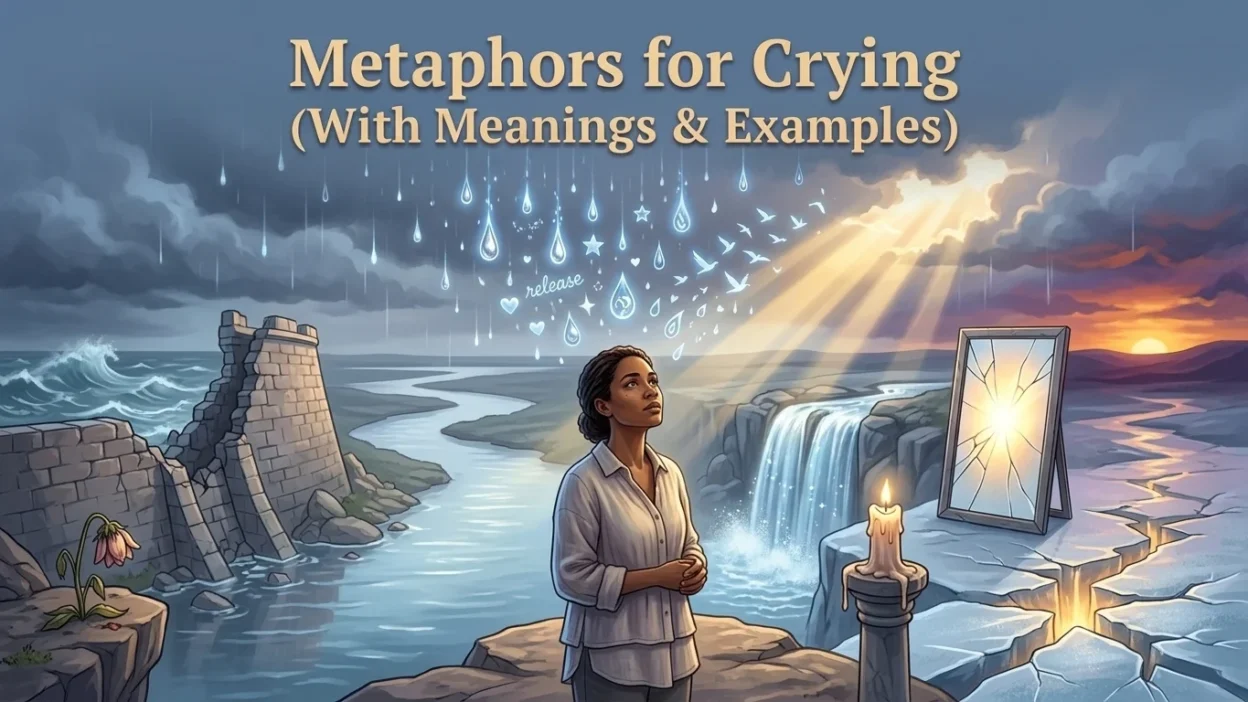
When you want to describe sadness or strong emotions, metaphors for crying can make your writing more vivid and meaningful. Instead of simply saying someone cried, you can compare their emotions to something readers can easily imagine. For example, saying “Her heart was a rainy sky” creates a stronger emotional picture.
A metaphor is a direct comparison that does not use “like” or “as.” In simple terms, it helps readers understand feelings through creative images. Metaphors are commonly used in stories, poems, songs, and speeches because they make emotions easier to feel and remember. Let’s explore 20 examples of metaphors for crying and learn how to use metaphors in writing.
20 Metaphors for Crying
1. A rainy sky
Meaning: Deep sadness.
Explanation: Rain represents tears.
Example 1: Her heart was a rainy sky.
Example 2: The room felt covered in clouds.
2. A broken dam
Meaning: Emotions burst out.
Explanation: Tears become impossible to stop.
Example 1: His emotions were a broken dam.
Example 2: Tears poured freely.
3. A melting candle
Meaning: Slowly losing strength.
Explanation: Wax melts away over time.
Example 1: She became a melting candle.
Example 2: Grief slowly consumed her.
4. A stormy sea
Meaning: Emotional turmoil.
Explanation: Strong waves symbolize powerful feelings.
Example 1: His heart was a stormy sea.
Example 2: Every memory created another wave.
5. A cracked mirror
Meaning: Emotional pain.
Explanation: Broken reflections represent hurt.
Example 1: Her heart became a cracked mirror.
Example 2: Nothing felt whole anymore.
6. A waterfall
Meaning: Constant tears.
Explanation: Water flows without stopping.
Example 1: Tears became a waterfall.
Example 2: She couldn’t stop crying.
7. A wilted flower
Meaning: Lost happiness.
Explanation: Flowers fade without care.
Example 1: He was a wilted flower.
Example 2: Sadness stole his joy.
8. A sinking ship
Meaning: Feeling overwhelmed.
Explanation: Losing hope.
Example 1: Her confidence was a sinking ship.
Example 2: Every setback pulled her deeper.
9. A dark cloud
Meaning: Lasting sadness.
Explanation: Clouds symbolize gloom.
Example 1: A dark cloud followed him.
Example 2: Joy seemed far away.
10. A frozen river
Meaning: Hidden emotions.
Explanation: Feelings remain trapped inside.
Example 1: His heart became a frozen river.
Example 2: He struggled to express himself.
11. A shattered vase
Meaning: A broken heart.
12. An autumn tree
Meaning: Letting emotions fall away.
13. A fading sunset
Meaning: Hope slowly disappearing.
14. A silent ocean
Meaning: Quiet sadness.
15. A heavy chain
Meaning: Emotional burden.
16. A dim candle
Meaning: Weak hope.
17. A shadow
Meaning: Lingering grief.
18. A closed door
Meaning: Withdrawing emotionally.
19. A lonely island
Meaning: Feeling isolated.
20. A gray horizon
Meaning: Sadness without a clear end.
Practical Exercise
- What is a metaphor?
- Complete: Her heart was a ________ sky.
- Which metaphor means emotions burst out?
- Which metaphor represents hidden emotions?
- What does “a waterfall” symbolize?
- Which metaphor means feeling overwhelmed?
- Which metaphor represents quiet sadness?
- Write your own metaphor for tears.
- Why do writers use metaphors?
- Which metaphor best describes grief?
Answers
- A direct comparison without using “like” or “as.”
- Rainy.
- A broken dam.
- A frozen river.
- Constant tears.
- A sinking ship.
- A silent ocean.
- Answers will vary.
- To make writing vivid and emotional.
- A stormy sea or a dark cloud.
Conclusion
Metaphors for crying help writers express sadness, grief, and emotional moments with greater depth. Instead of repeatedly saying someone cried, you can describe emotions through images such as a rainy sky, a broken dam, a stormy sea, or a waterfall. These examples of metaphors make your creative writing more engaging and memorable. Practice using your own metaphors to describe emotions, and your stories and poems will become more powerful.