Introduction
Fear is one of the strongest emotions people experience. It can protect us from danger, but it can also stop us from chasing our dreams. Because fear is often difficult to describe, writers use metaphors for fear to create vivid pictures that readers can easily understand. Instead of simply saying someone was afraid, a metaphor helps readers feel the emotion through powerful imagery. As a result, your writing becomes more engaging, emotional, and memorable.
For example, instead of writing, “She was afraid,” you could write, “Fear was a dark shadow following her.” Immediately, readers imagine fear staying close wherever she goes. Likewise, instead of saying, “His fear grew,” you might write, “Fear became a growing storm.” These creative comparisons make stories, essays, speeches, and poems much more expressive.
In simple terms, metaphors transform ordinary descriptions into unforgettable images. Whether you’re writing for school or simply improving your creative writing skills, learning how to use metaphors in writing will help your ideas stand out. So, let’s explore 20 metaphors for fear, understand their meanings, read practical examples of metaphors, and practice using them with confidence.
What Is a Metaphor?
A metaphor is a figure of speech that directly compares one thing to another without using like or as.
Example
Fear is a dark shadow.
This doesn’t mean fear is literally a shadow. Instead, it means fear can follow someone closely and make everything seem uncertain.
The meaning of metaphors is to explain ideas through vivid and creative comparisons that make writing stronger and easier to imagine.
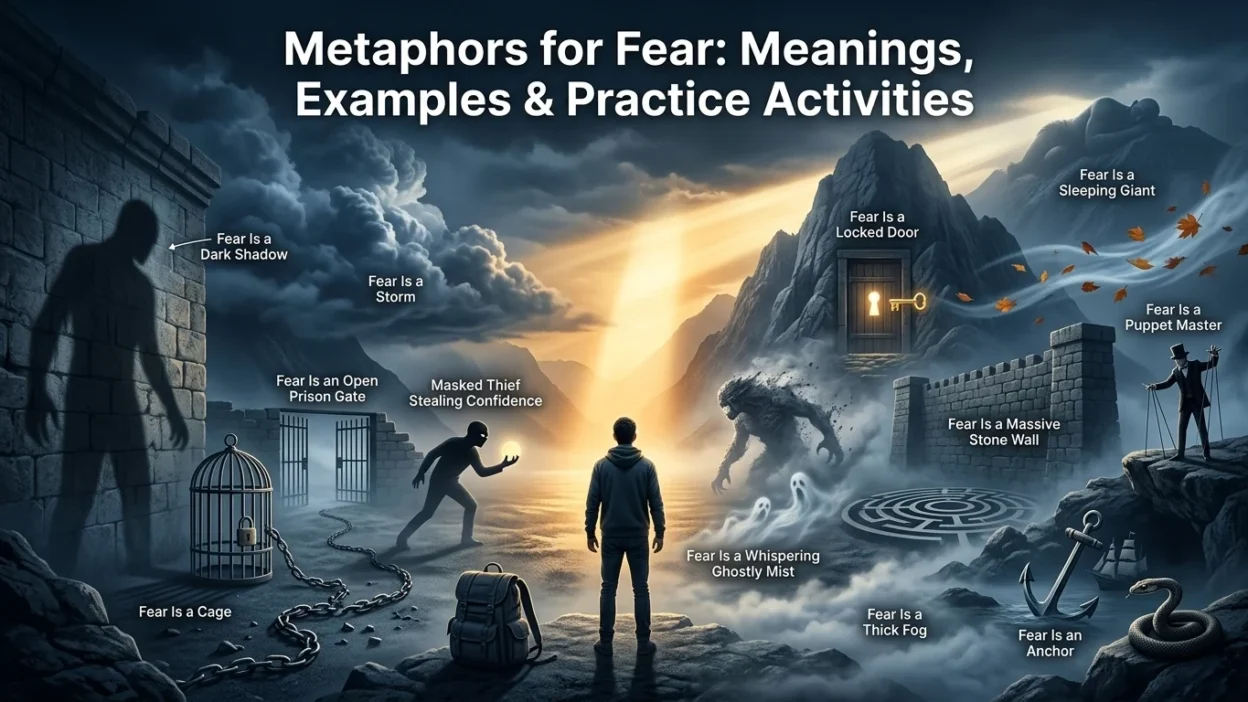
20 Metaphors for Fear
1. Fear Is a Dark Shadow
Meaning: Fear follows you and feels difficult to escape.
Explanation: Shadows stay close until light appears.
Example Sentences:
- Fear became a dark shadow behind him.
- She stepped into confidence, and the shadow disappeared.
2. Fear Is a Cage
Meaning: Fear limits your freedom.
Explanation: A cage prevents movement.
Example Sentences:
- Fear became a cage around his dreams.
- She finally broke free from the cage.
3. Fear Is a Storm
Meaning: Fear brings emotional turmoil.
Explanation: Storms create chaos but eventually pass.
Example Sentences:
- Fear became a violent storm.
- Calmness slowly cleared the storm.
4. Fear Is Ice
Meaning: Fear stops action.
Explanation: Ice freezes movement.
Example Sentences:
- Fear turned his courage into ice.
- Determination melted the ice.
5. Fear Is a Wall
Meaning: Fear blocks progress.
Explanation: Walls stop people from moving forward.
Example Sentences:
- Fear became a tall wall.
- Confidence helped her climb over it.
6. Fear Is a Whisper
Meaning: Fear quietly fills your mind with doubt.
Explanation: Whispers are soft but powerful.
Example Sentences:
- Fear whispered that he would fail.
- Hope spoke louder than the whisper.
7. Fear Is a Chain
Meaning: Fear keeps you trapped.
Explanation: Chains restrict movement.
Example Sentences:
- Fear wrapped chains around her confidence.
- She broke every chain with courage.
8. Fear Is a Fog
Meaning: Fear creates confusion.
Explanation: Fog makes it difficult to see clearly.
Example Sentences:
- Fear covered his future with fog.
- Optimism cleared the path.
9. Fear Is a Monster
Meaning: Fear feels overwhelming.
Explanation: Monsters seem frightening until faced.
Example Sentences:
- Fear became a monster in his mind.
- He defeated the monster by taking action.
10. Fear Is a Prison
Meaning: Fear traps people emotionally.
Explanation: A prison limits freedom.
Example Sentences:
- Fear became an invisible prison.
- Courage unlocked every door.
11. Fear Is a Thief
Meaning: Fear steals opportunities.
Explanation: Thieves take valuable things away.
Example Sentences:
- Fear stole her confidence.
- She refused to let the thief win.
12. Fear Is a Heavy Backpack
Meaning: Fear becomes a burden.
Explanation: Heavy loads slow your journey.
Example Sentences:
- Fear became a heavy backpack.
- He continued walking despite the weight.
13. Fear Is a Maze
Meaning: Fear makes decisions confusing.
Explanation: Mazes have many wrong turns.
Example Sentences:
- Fear became a maze.
- She found the exit with patience.
14. Fear Is a Snake
Meaning: Fear strikes unexpectedly.
Explanation: Snakes often surprise people.
Example Sentences:
- Fear became a snake in the grass.
- Confidence stood its ground.
15. Fear Is a Mountain
Meaning: Fear seems impossible to overcome.
Explanation: Mountains require effort to climb.
Example Sentences:
- Fear became a mountain.
- Every step made the climb easier.
16. Fear Is a Locked Door
Meaning: Fear blocks new opportunities.
Explanation: Locked doors require courage to open.
Example Sentences:
- Fear became a locked door.
- She found the key through persistence.
17. Fear Is a Puppet Master
Meaning: Fear controls your actions.
Explanation: Puppet masters control movement.
Example Sentences:
- Fear became the puppet master.
- Confidence cut the strings.
18. Fear Is a Cold Wind
Meaning: Fear creates discomfort.
Explanation: Cold winds make people uneasy.
Example Sentences:
- Fear blew through the room.
- Hope brought warmth again.
19. Fear Is an Anchor
Meaning: Fear holds you back.
Explanation: Anchors stop ships from moving.
Example Sentences:
- Fear became an anchor.
- Determination lifted it.
20. Fear Is a Sleeping Giant
Meaning: Fear grows stronger when ignored.
Explanation: Giants become powerful when awakened.
Example Sentences:
- Fear remained a sleeping giant.
- Facing it kept the giant asleep.
Practical Exercise
Questions
- Complete the metaphor: Fear is a dark ______.
- Which metaphor represents confusion?
- What does fear is a thief mean?
- Complete the metaphor: Fear is a heavy ______.
- Which metaphor symbolizes emotional imprisonment?
- What does fear is a cage suggest?
- Complete the metaphor: Fear is a cold ______.
- Which metaphor represents control over your actions?
- What does fear is an anchor symbolize?
- Which metaphor shows fear blocking opportunities?
Answers and Explanations
1. Shadow – Fear follows closely.
2. A Fog – Fear clouds clear thinking.
3. Fear steals confidence and opportunities – It prevents personal growth.
4. Backpack – Fear becomes a burden.
5. A Prison – Fear traps people emotionally.
6. Fear limits freedom – It prevents people from taking action.
7. Wind – Fear creates discomfort and uncertainty.
8. A Puppet Master – Fear controls decisions and behavior.
9. It holds you back – Fear stops progress.
10. A Locked Door – Fear prevents new experiences and opportunities.
How to Create Your Own Metaphors
Creating metaphors is simple.
1: First, think about how fear feels.
2: Next, choose an object, place, or event that shares similar qualities.
3: Then, write the comparison without using like or as.
Examples
- Fear is a silent alarm.
- Fear is a cracked mirror.
- Fear is an invisible chain.
The more you practice, the more naturally you’ll use creative writing metaphors. Consequently, your writing will become more emotional, descriptive, and memorable.
Conclusion
Fear is a powerful emotion, but metaphors help you describe it in ways that readers can instantly understand. Instead of using simple descriptions, you can create vivid images that show how fear affects thoughts, emotions, and actions. Throughout this guide, you’ve explored examples of metaphors, learned the meaning of metaphors, and practiced how to use metaphors in writing.
Now it’s your turn. Think about a moment when you felt afraid and create your own original metaphor. With regular practice, you’ll write essays, stories, speeches, and poems that connect with readers through strong imagery and creative expression.