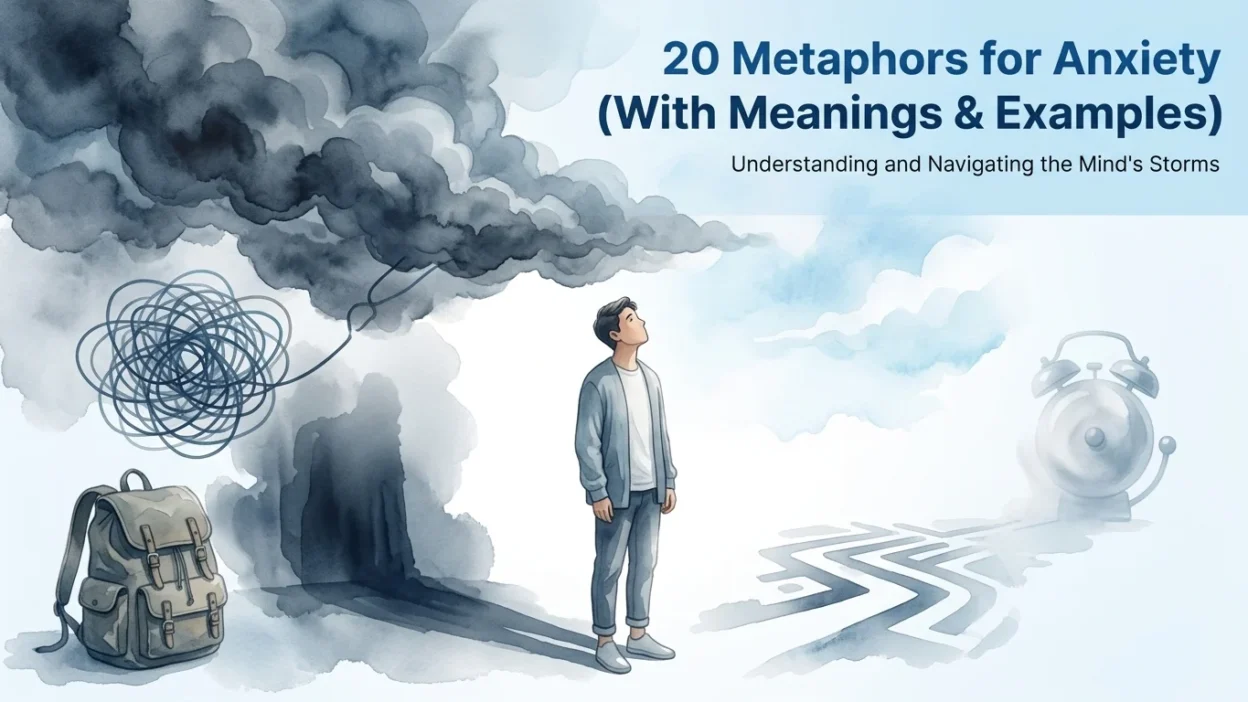
Anxiety can be difficult to explain because it is a feeling, not something you can see. That’s where metaphors help. A metaphor compares one thing to another without using “like” or “as.” It paints a clear picture in the reader’s mind and makes emotions easier to understand.
For example, instead of saying, “I felt anxious,” you might say, “Anxiety was a storm inside me.” This creates a stronger image and helps readers feel the emotion.
Let’s explore some creative writing metaphors and see how to use metaphors in writing.
20 Metaphors for Anxiety
1. Anxiety is a storm.
Meaning: Anxiety feels wild and overwhelming.
Example 1: Anxiety was a storm before the interview.
Example 2: The storm inside her finally calmed.
2. Anxiety is a heavy backpack.
Meaning: Anxiety feels like carrying extra weight.
Example 1: He carried a heavy backpack of worry.
Example 2: Every task made the backpack heavier.
3. Anxiety is a cage.
Meaning: Anxiety makes you feel trapped.
Example 1: Anxiety became a cage around her thoughts.
Example 2: He wanted to escape the cage.
4. Anxiety is a shadow.
Meaning: It follows you everywhere.
Example 1: Anxiety was his constant shadow.
Example 2: The shadow stayed all day.
5. Anxiety is quicksand.
Meaning: The more you struggle, the worse it feels.
Example 1: She sank into anxiety like quicksand.
Example 2: Every worry pulled him deeper.
6. Anxiety is an alarm bell.
Meaning: It keeps warning you.
Example 1: The alarm bell never stopped ringing.
Example 2: Anxiety sounded another warning.
7. Anxiety is a tangled knot.
Meaning: Thoughts become confusing.
Example 1: His mind became a tangled knot.
Example 2: She couldn’t untie her worries.
8. Anxiety is a wildfire.
Meaning: It spreads very quickly.
Example 1: One fear became a wildfire.
Example 2: The wildfire reached every thought.
9. Anxiety is dark clouds.
Meaning: It blocks hope.
Example 1: Dark clouds filled her mind.
Example 2: The clouds slowly passed.
10. Anxiety is a ticking clock.
Meaning: It creates constant pressure.
Example 1: Anxiety became a ticking clock.
Example 2: Every second increased his stress.
11. Anxiety is a maze.
Meaning: It makes you feel lost.
Example 1: She wandered through a maze of worry.
Example 2: He searched for a way out.
12. Anxiety is icy water.
Meaning: It causes fear and discomfort.
Example 1: Icy water rushed through him.
Example 2: The cold feeling stayed.
13. Anxiety is a volcano.
Meaning: Emotions build until they explode.
Example 1: Anxiety was a volcano ready to erupt.
Example 2: He feared the eruption.
14. Anxiety is a prison.
Meaning: It limits freedom.
Example 1: Anxiety became a prison.
Example 2: She longed to escape.
15. Anxiety is a buzzing bee.
Meaning: It constantly distracts you.
Example 1: Anxiety buzzed in his mind.
Example 2: The buzzing never stopped.
16. Anxiety is a racing engine.
Meaning: Thoughts move too fast.
Example 1: His mind became a racing engine.
Example 2: The engine refused to slow.
17. Anxiety is an invisible weight.
Meaning: It feels heavy but unseen.
Example 1: She carried an invisible weight.
Example 2: The weight drained her energy.
18. Anxiety is a broken compass.
Meaning: It makes decisions difficult.
Example 1: His compass pointed nowhere.
Example 2: Anxiety stole his direction.
19. Anxiety is a noisy crowd.
Meaning: Too many thoughts compete.
Example 1: A noisy crowd filled her head.
Example 2: She searched for silence.
20. Anxiety is a cracked mirror.
Meaning: Anxiety changes how you see yourself.
Example 1: He looked through a cracked mirror.
Example 2: The mirror distorted every thought.
Practice Questions
- What is a metaphor?
- Complete: Anxiety is a ________.
- Which metaphor means feeling trapped?
- Which metaphor represents confusion?
- Which metaphor spreads quickly?
- Which metaphor shows pressure?
- Which metaphor means carrying emotional weight?
- Which metaphor follows you everywhere?
- Write your own metaphor for anxiety.
- Explain why metaphors improve writing.
Answers
- A comparison without using “like” or “as.”
- Any suitable answer.
- A cage.
- A tangled knot.
- A wildfire.
- A ticking clock.
- A heavy backpack or invisible weight.
- A shadow.
- Answers may vary.
- They make emotions easier to imagine and understand.
Conclusion
Metaphors make anxiety easier to describe and understand. They turn difficult emotions into clear pictures that readers can imagine. These examples of metaphors can improve your creative writing and help you express feelings with confidence. Keep practicing, create your own metaphors, and you’ll soon discover how to use metaphors in writing more naturally and effectively.